

Many people want to read faster, but they worry that speed will damage understanding.
That concern is valid.
Reading faster is only useful if you still understand what matters. If you move your eyes quickly but cannot explain what you read, you have not improved your reading. You have only rushed through the text.
The goal is not to force yourself through every page at maximum speed. The goal is to build better control. You should know when to move faster, when to slow down, and how to check whether your comprehension is still strong enough for the task.
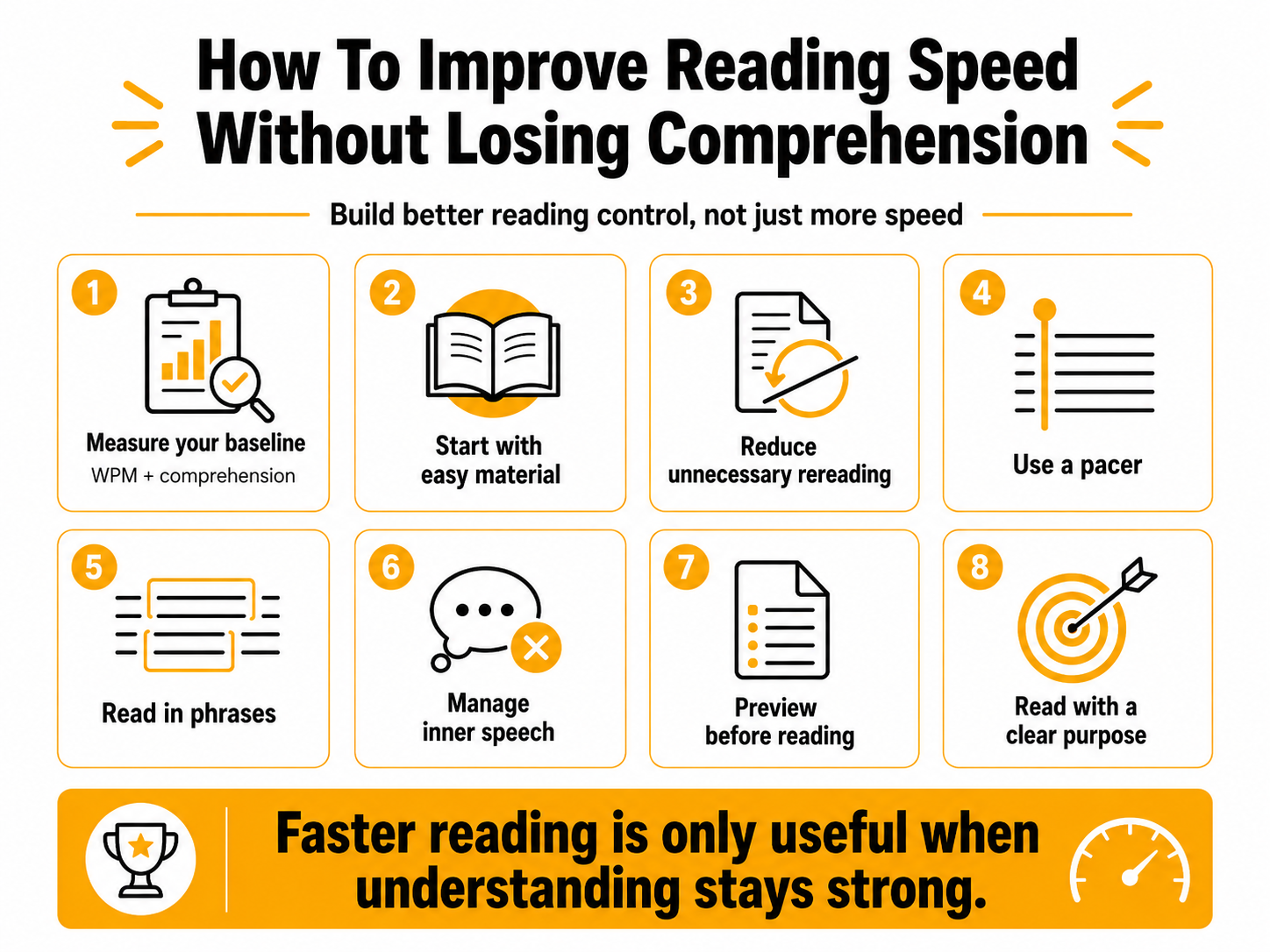
You can improve reading speed without losing comprehension by measuring your current reading pace, practising on suitable material, reducing unnecessary rereading, using a pacer, reading in phrases, managing inner speech, and checking comprehension after each session.
The safest approach is to increase speed gradually. Start with easier material, practise in short sessions, and only increase pace when you can still explain the main idea clearly.
{{EMBED}}
Reading speed and comprehension are connected.
When you read faster, your brain has less time to process each word, connect ideas, and store meaning. This is why extreme speed reading claims often fail. Moving faster is easy. Understanding faster is harder.
Comprehension can drop when you:
This does not mean reading faster is impossible. It means speed must be trained carefully.
Good readers do not use one speed for every text. They adjust their pace based on difficulty, purpose, and importance.
Before trying to improve, you need a baseline.
Measure how many words per minute you currently read on normal material. Then check how much you understood.
A simple method:
This gives you two scores:
Speed alone is not enough. If your WPM increases but your recall drops badly, the method is not working.
For a deeper benchmark, read our guide on what makes a good reading speed.
Do not start with your hardest reading.
If you practise speed improvement on legal, medical, academic, or highly technical material, comprehension will usually suffer. Difficult text requires slower processing.
Start with material that is clear and familiar, such as:
Once you can read easier material faster while keeping comprehension, move to more demanding texts.
This matters because speed reading is not about treating every text the same way. It is about learning control.
Many readers lose time because they keep going back over sentences.
Sometimes rereading is useful. If a sentence is important, complex, or confusing, going back is the right decision.
The problem is unnecessary rereading, also known as regression in reading.
This happens when your eyes jump backwards out of habit, not because the meaning was unclear. It breaks flow and makes reading feel slower than it needs to be.
To reduce it:
The aim is not to ban rereading completely. The aim is to stop rereading automatically.
A pacer is a finger, pen, cursor, or pointer that guides your eyes across the line.
This can help because many readers read passively. Their eyes stop, drift, or jump backwards without them noticing.
A pacer gives your eyes a clear path.
Use it gently:
A pacer is not magic. It simply gives structure to your eye movement. For many readers, that structure is enough to reduce hesitation and improve flow.
For more methods, read our guide to speed reading techniques.
Slow readers often process text word by word.
Faster readers usually take in short groups of words. This is called phrase reading.
For example, instead of reading like this:
“Many / people / want / to / read / faster”
You start seeing it more like this:
“Many people / want to read faster”
This helps because meaning often comes from groups of words, not isolated words.
To practise:
Do not force huge chunks. Start with two or three words at a time. The goal is smoother meaning, not visual tricks.
Most readers hear some form of inner voice while reading.
This is called subvocalising. It means mentally saying words as you read them.
Subvocalising is not always bad. It can help with difficult material, unfamiliar language, and careful reading. But if you mentally pronounce every word at full speaking speed, it can slow you down.
The goal is not to silence your mind completely.
Instead, try to reduce inner speech when the material is easy enough. Let your eyes move through simple phrases without saying every word clearly in your head.
A useful practice:
For a full explanation, read our guide on how to stop subvocalising while reading.
Previewing helps comprehension because it gives your brain a map before you start.
Before reading a full article, chapter, or report, quickly look at:
This does not mean skimming instead of reading. It means preparing your mind for what is coming.
When you already know the structure, you can read faster because your brain is not trying to organise everything from zero.
Previewing is especially useful for:
It helps you understand where the important ideas are likely to appear.
Not every text deserves the same reading speed.
Before reading, ask:
“What do I need from this?”
Your answer changes how you should read.
If you need a general idea, you can move faster.
If you need detailed accuracy, you should slow down.
If you need to compare options, you may skim first and then read key sections carefully.
If you need to remember information for an exam, you need more pauses and recall checks.
Purpose controls pace.
Without a purpose, readers often move too slowly through easy material and too quickly through difficult material.
Comprehension should be tested simply.
After a reading session, ask yourself:
If you cannot answer, slow down.
This quick check stops you from confusing speed with progress. It also trains active reading, which is more useful than just moving your eyes faster.
You do not need a long test every time. A short recall check is enough to show whether your reading speed is still useful.
You can practise reading speed in short daily sessions.
Read for 5 minutes and record your WPM and comprehension.
Use a finger or cursor to guide your eyes smoothly through simple material.
Notice when your eyes jump backwards. Keep moving unless meaning breaks down.
Read in small groups of words instead of stopping on every word.
Read simple material while focusing on meaning rather than mentally pronouncing every word.
Read an easy text faster, then read a difficult text slower. Notice the difference.
Use similar material to your Day 1 test. Compare speed and comprehension.
The goal is not perfection in one week. The goal is to build awareness and control.

Very high WPM numbers look impressive, but they are not useful if comprehension collapses.
Focus on practical improvement first.
You should not speed read every text. Some material deserves slow, careful reading.
If you never test understanding, you cannot know whether your speed has improved properly.
Practice on easier material first. Then apply the skill to harder reading gradually.
Inner speech is not the enemy. It just needs to be managed.
You should slow down when reading:
Fast reading is useful when the text allows it. Slow reading is useful when accuracy matters more than speed.
Strong readers know how to switch between both.

Your reading speed is improving when:
The best result is not just a higher WPM number. The best result is better reading judgment.

You can improve reading speed without losing comprehension, but only if you train speed and understanding together.
Do not chase fast reading for its own sake. Start with your current pace, practise on suitable material, reduce unnecessary rereading, use a pacer, read in phrases, manage your inner voice, and check your understanding.
The real goal is controlled reading.
When you can choose the right pace for the right text, you become a more effective reader.
If you want a structured way to practise this, the Speed Reading Mastery course gives you a guided 7-day training path with reading tests, pacing practice, and comprehension-focused exercises.
Yes, but you need to increase speed gradually and check comprehension as you practise. If your understanding drops too much, slow down and rebuild control.
Many readers can notice small improvements within a week of focused practice. Stronger improvement usually takes longer because your eyes, focus, and reading habits need repetition.
A good reading speed depends on the material and your purpose. For many adults, normal reading often falls around a few hundred words per minute, but comprehension matters more than the number alone.
No. Subvocalising can help with difficult or important material. The goal is to reduce unnecessary inner speech when the text is simple enough, not remove it completely.
Yes, if students use it carefully. It can help with easier reading, revision, and overview work, but dense academic material still needs slower reading and active recall.