

There are many speed reading techniques online. Some are useful. Some are misunderstood. Some sound impressive but do not help much when comprehension matters.
The best techniques do not work by forcing your eyes to move as fast as possible. They work by helping you remove wasted habits, stay focused, understand the structure of a text, and choose the right pace for the material in front of you.
This guide explains which techniques can genuinely help increase reading speed, which ones to treat carefully, and what to practise first.
For the broader overview of the skill itself, read our guide on what speed reading is.
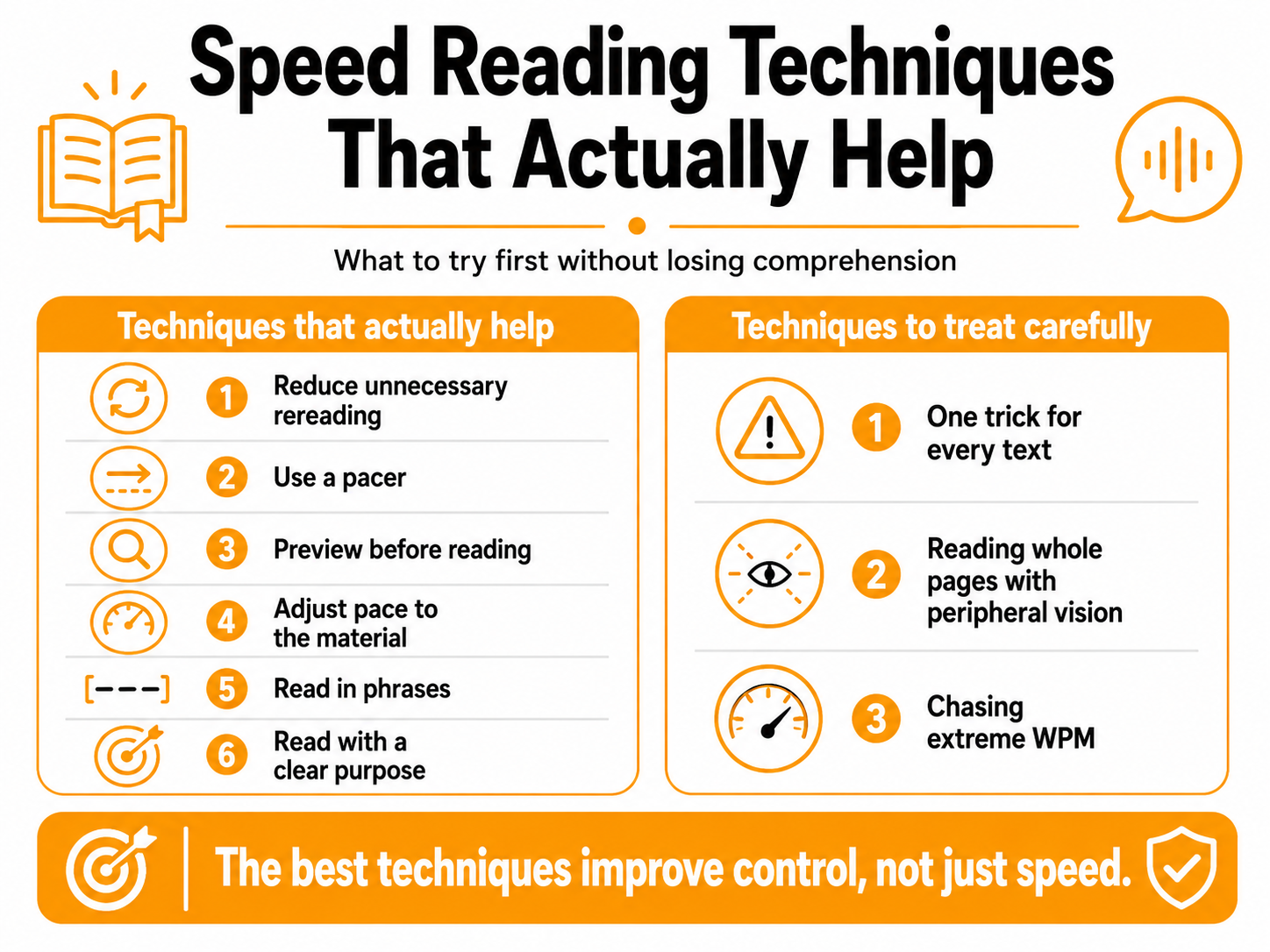
The most useful speed reading techniques are the ones that improve control.
Start with techniques that reduce unnecessary rereading, improve focus, preview the structure of a text, and help you adjust pace based on difficulty.
After that, you can practise phrase reading, chunking, and managing inner speech on suitable material.
Be careful with techniques that promise extreme words per minute, perfect comprehension at very high speeds, or reading full pages through peripheral vision.
{{EMBED}}
A useful speed reading technique should improve reading efficiency without damaging understanding.
That means it should help you get more value from your reading time, not simply make your eyes move faster.
A technique is worth practising if it helps you:
A technique is less useful if it only increases words per minute while your understanding gets weaker.
This is why speed should never be judged on its own.
Regression means going back and rereading words, lines, or paragraphs.
Some regression is useful. If a sentence is confusing, rereading it carefully makes sense. The problem is automatic regression, where your eyes keep jumping back even when you understood the text the first time.
This habit can slow readers down without adding much value.
To practise reducing unnecessary regression, read a short passage with the goal of moving forward steadily. Do not rush. Simply notice when your eyes want to jump back out of habit.
After each paragraph, pause and check whether you understood the main idea. If you do, keep going. If not, reread deliberately.
The goal is not to ban rereading. The goal is to stop rereading by default.
A pacer is a simple visual guide, such as your finger, a pen, or the cursor on a screen.
It helps your eyes move forward in a controlled way. This can reduce drifting, hesitation, and unnecessary backtracking.
A pacer works best when it is used gently. If you move it too fast, comprehension will drop. If you move it steadily, it can help you maintain rhythm and focus.
Start by moving the pacer just slightly faster than your normal reading pace. After a short section, stop and explain the main point in your own words.
If you understand the text, the pace is reasonable. If you lose the meaning, slow down.
Previewing means looking at the structure of a text before reading it fully.
This may include the title, headings, subheadings, introduction, conclusion, bullet points, summaries, images, or key terms.
Previewing helps because your brain reads better when it has a map. You know what the text is about, where the main ideas are likely to appear, and which sections may need more attention.
This does not mean replacing reading with skimming. It means using a short preview to make the full read more purposeful.
For the difference between these reading modes, read our guide on speed reading vs skimming.
One of the most important reading techniques is also the simplest: do not read everything at the same speed.
A simple article, a familiar report, a textbook explanation, and a legal clause should not be read with one fixed pace.
Faster reading works better when the material is familiar, simple, or low risk. Slower reading is better when the text is dense, technical, academic, financial, legal, or emotionally nuanced.
A strong reader changes pace based on the task.
This technique protects comprehension because it stops you from forcing speed where careful reading is needed.
Many readers slow down because they process text word by word.
Phrase reading means taking in small groups of words as units of meaning. Instead of treating every word as a separate stop, you begin to recognise short phrases and ideas together.
This can make reading smoother, especially on straightforward material.
For example, a reader may move from:
“Many / readers / slow / down / because / they / read / every / word / separately”
to:
“Many readers slow down / because they read / every word separately”
The second approach is not about skipping words. It is about processing meaning in slightly larger units.
Start with easy text. Do not practise phrase reading on material that needs close analysis.
Some readers slow down because they mentally pronounce every word as they read.
This inner speech can help with difficult material, but it may not be needed at the same level for simple or familiar text.
The goal is not to remove it completely. The goal is to reduce word-by-word dependence when the material allows it.
You can practise this by reading in phrases, using a steady pace, and focusing on the meaning of each sentence instead of the sound of every word.
For a deeper guide, read our article on how to stop subvocalising while reading.
Reading purpose affects reading speed more than many people realise.
Before starting, ask what you need from the text.
Are you reading for a general idea?
Are you looking for one specific point?
Are you trying to understand the full argument?
Are you studying something you will need to remember later?
Each purpose needs a different pace.
If you only need a quick overview, skimming may be enough. If you need the full content, speed reading may be more appropriate. If exact wording matters, slow reading is safer.
Purpose stops you from wasting the same level of attention on every text.
Some speed reading advice presents one method as the answer to every reading problem.
That is rarely useful.
A pacer may help with focus. Previewing may help with structure. Phrase reading may help with smoother processing. Slower reading may still be necessary when the material is dense or important.
Good reading improvement comes from choosing the right technique for the task, not forcing one technique onto every text.
Another common claim is that readers can train peripheral vision to absorb full lines or pages at once.
This is often overstated.
Peripheral vision can support awareness around the point of focus, but it does not replace meaningful processing of words and phrases.
If someone moves through a page very quickly and only gets the general idea, that may be skimming, not full reading.
This does not mean visual training is useless. It means the claim should stay realistic.
Words per minute can be useful, but it can also be misleading.
A higher WPM score only matters if comprehension stays strong enough for the task.
If you read faster but cannot explain the main idea, remember key points, or use what you read, the number is not meaningful.
Our guide to what makes a good reading speed explains how to think about WPM benchmarks properly.
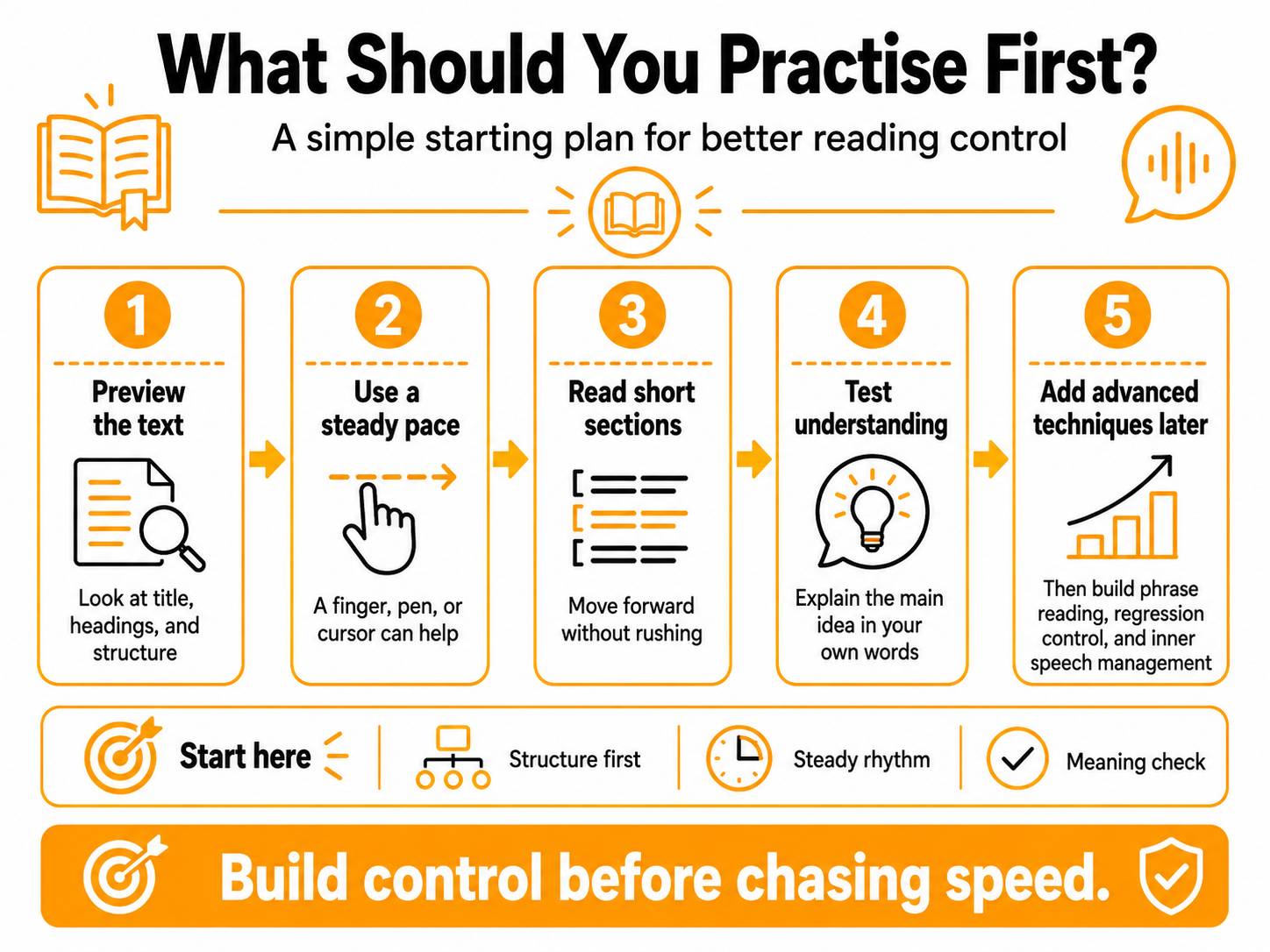
If you are starting from scratch, do not practise every technique at once.
Start with three simple habits.
First, preview the text before reading. This gives your brain a structure.
Second, use a steady pace. A finger, pen, or cursor can help if your focus drifts.
Third, test understanding after short sections. If you can explain the main idea, continue. If not, slow down.
Once these habits feel natural, add phrase reading, regression control, and inner speech management.
The goal is not to become fast on every text. The goal is to build better reading control.
A speed reading technique is working if it improves efficiency without weakening understanding.
Track more than speed.
Check whether you can:
Also test on similar text types. A simple article and a dense academic chapter should not be compared directly.
Good progress feels controlled. You are not rushing. You are choosing a better pace for the task.
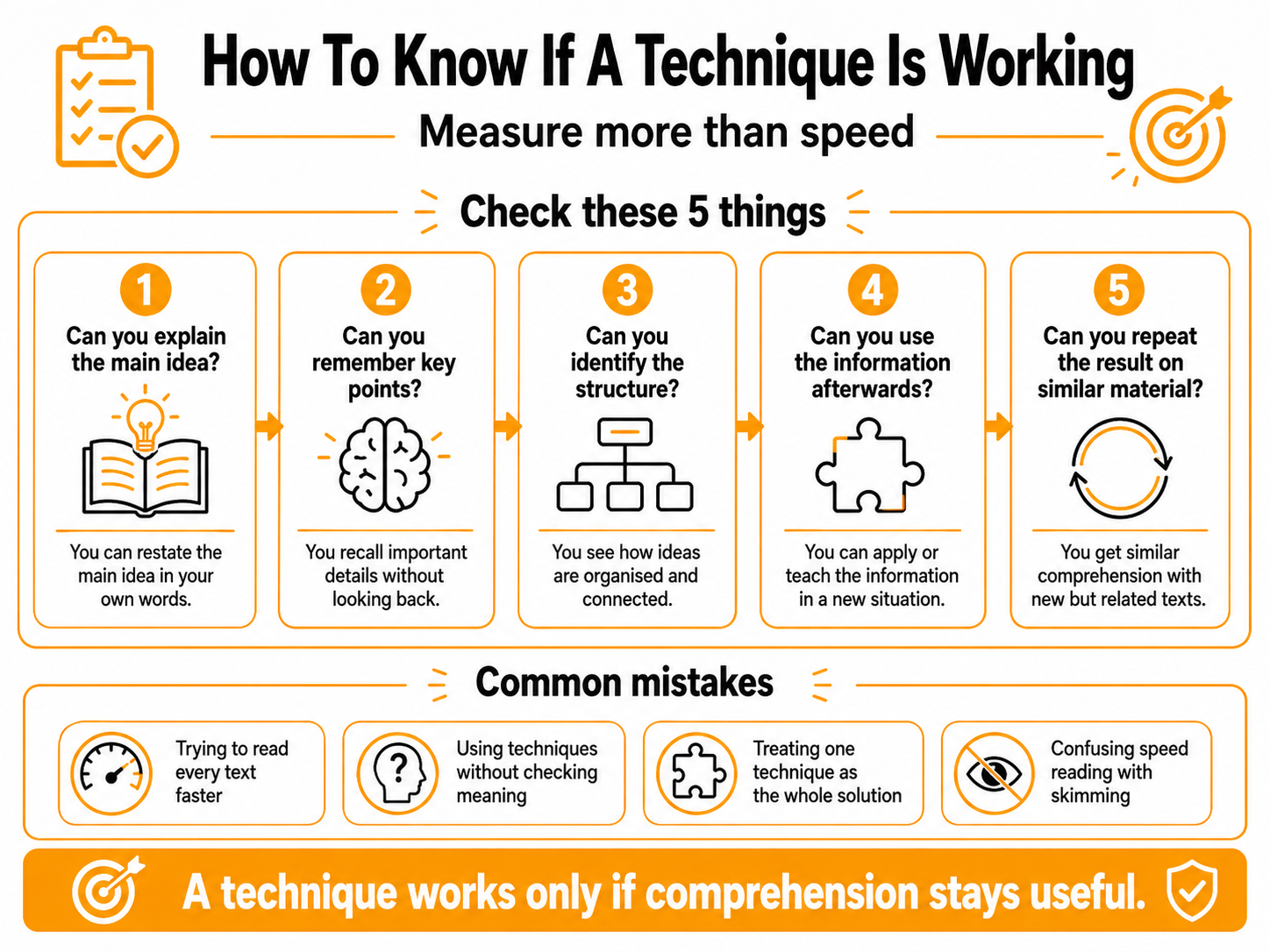
The first mistake is trying to read every text faster.
Some material needs slow reading. Technical, academic, legal, medical, financial, or detailed writing often requires careful attention.
The second mistake is using techniques without checking meaning. Speed without understanding is not progress.
The third mistake is treating one technique as the whole solution. A pacer, phrase reading, previewing, and pace control all help in different ways, but none of them works for every situation.
The fourth mistake is confusing speed reading with skimming. Skimming is useful when you only need the general idea. Speed reading is more useful when the full content still matters.
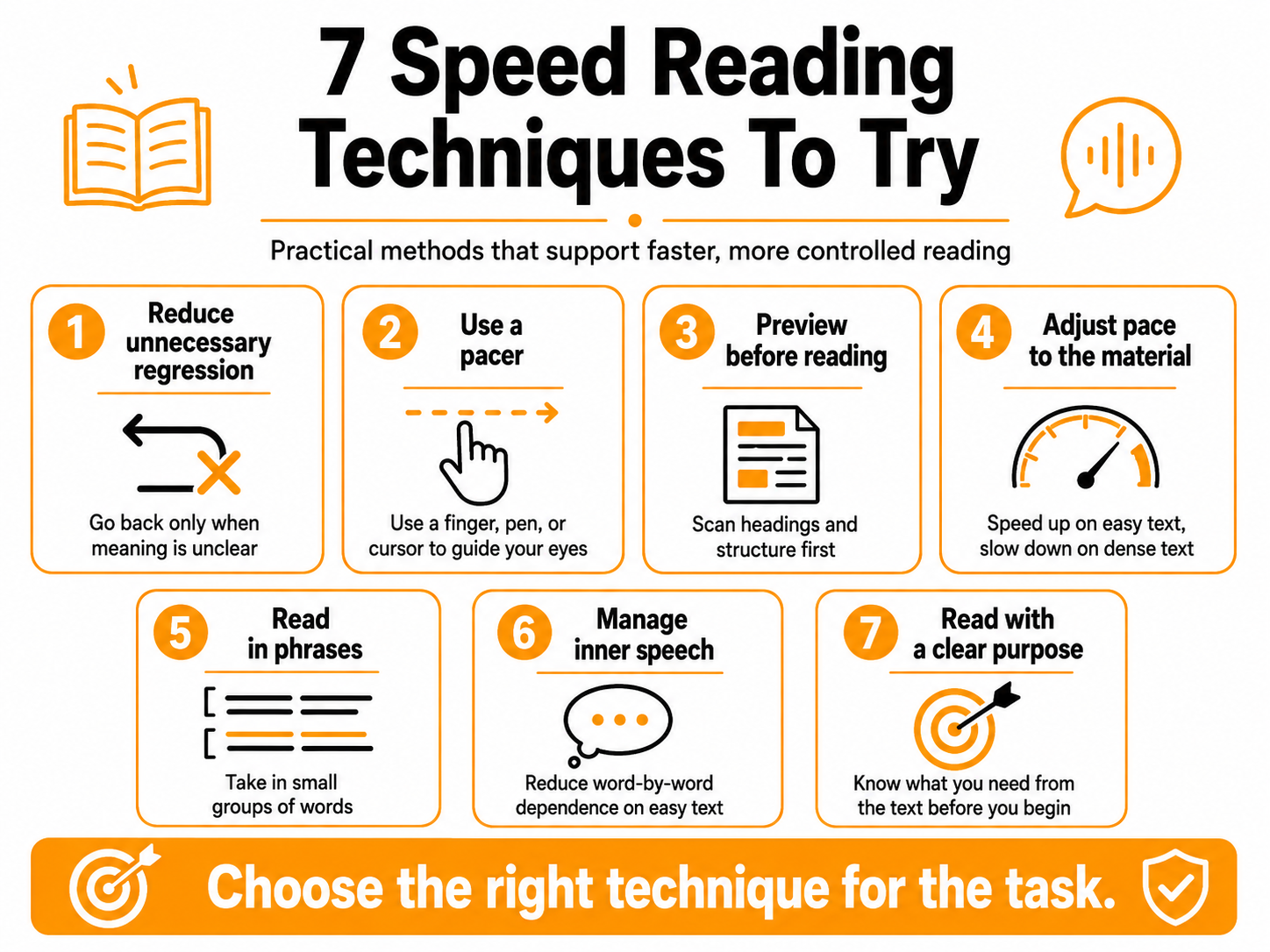
The best speed reading techniques are practical, not extreme.
Reducing unnecessary regression, using a steady pacer, previewing structure, reading in phrases, managing inner speech, and adjusting pace to the material can all help readers become more efficient.
The techniques to avoid are the ones that promise speed without understanding.
If poor focus, rereading, or one-speed reading habits are holding you back, StudyFast’s Speed Reading Mastery course can help you practise the techniques that actually support faster, more controlled reading.
The best starting technique is usually previewing the text and using a steady pace. These improve focus and control without forcing speed too aggressively.
Yes, some can. Techniques like previewing, reading with purpose, and checking understanding can make reading more focused. But techniques that only push speed can reduce comprehension.
Yes, for many readers. A finger, pen, or cursor can act as a pacer and help the eyes move forward more steadily.
Sometimes. It can help on simple material, but you should not force it on difficult text. If inner speech supports understanding, keep it.
Skimming is a separate reading mode. It is useful for getting an overview, but it is not the same as reading the full text efficiently.
You are reading too fast if you cannot explain the main idea, remember key points, or use what you read afterwards.
Beginners should start with previewing, steady pacing, and short understanding checks before moving into phrase reading, regression control, or inner speech management.