
Speed reading is the practice of reading faster by improving eye movement, reducing unnecessary rereading, and choosing the right pace for the material. The goal is not just more words per minute. The goal is to read efficiently while keeping enough comprehension to understand and use what you read.
For students and professionals, the problem is not only slow reading. It is having too much to read and not always knowing what needs close attention. Textbooks, notes, reports, emails, research, and long articles all need different levels of focus.
In this guide, we will break down what speed reading means, how it works, who it helps, which techniques matter, and how to improve reading speed without damaging comprehension.
Speed reading is a structured way to read faster while still understanding the main message. It sits between careful reading and skimming. You are not trying to give every sentence the same attention. You are learning how to adjust your pace based on the purpose and difficulty of the text.
At its core, speed reading is about:
• Reading with a clear purpose
• Reducing unnecessary rereading
• Improving focus and eye movement
• Matching speed to the material
• Protecting comprehension
{{EMBED}}
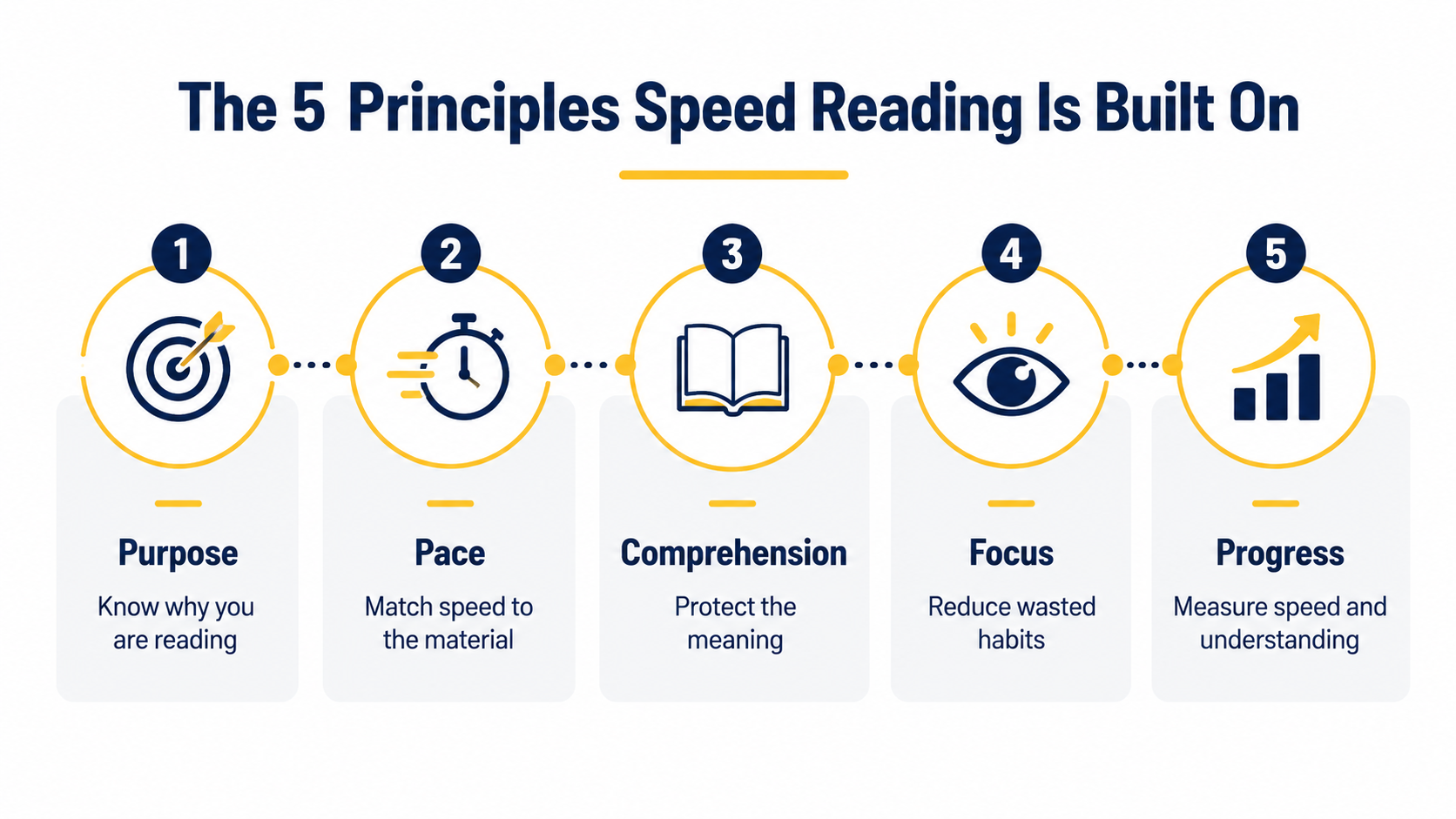
Speed reading works best when it follows practical reading principles.
Before you read faster, know why you are reading. Are you looking for the main idea, reviewing familiar notes, studying for an exam, or checking exact wording? Your purpose decides your pace.
Not every text should be read at the same speed. A simple article, a textbook chapter, a legal document, and a work report all need different reading behaviour.
Speed only helps when understanding stays strong enough for the task.
Many readers lose time through automatic rereading, drifting attention, weak previewing, or reading every word with the same slow rhythm.
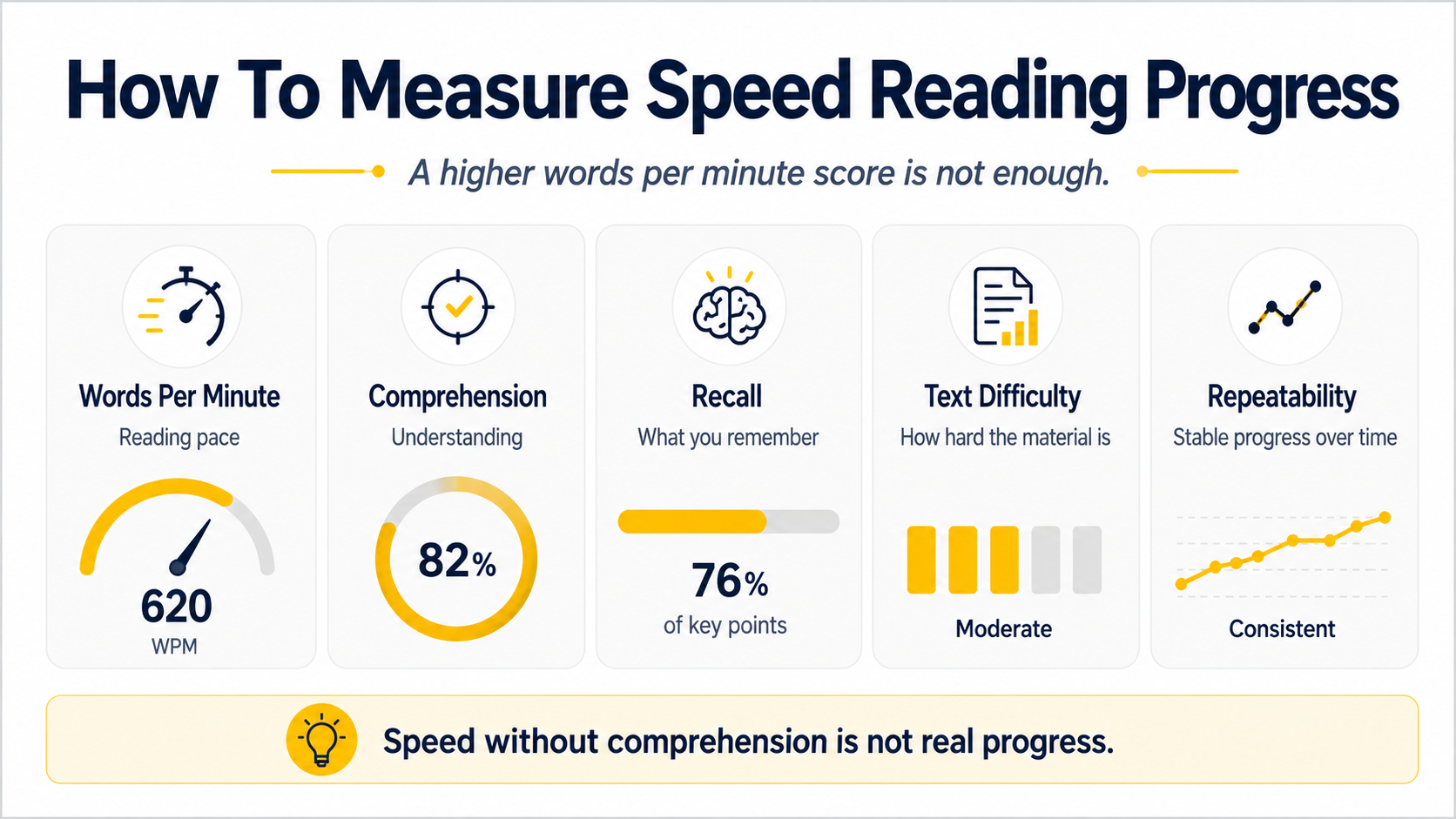
Words per minute matters, but it should never be measured alone. Real progress includes speed, comprehension, recall, and repeatability.
Reading is not a smooth slide across the page. Your eyes move in quick jumps called saccades, then pause at fixations so your brain can process the words.
That means your eyes can move faster, but your brain still needs time to understand meaning. This is why Good speed reading works better on familiar or simple material and becomes harder with dense, technical, academic, legal, or medical text.
Speed reading training is most useful when reading volume is the problem, not when every sentence needs deep analysis.
Students can use speed reading to manage notes, textbook chapters, articles, and revision material with less wasted rereading.
Professionals can use it for emails, reports, proposals, meeting notes, and research, especially when they need to find what matters quickly.
Exam candidates can use speed reading during review, but not as a replacement for deep study when a topic is still unclear.
Busy readers can use it to read with more intention and decide what deserves close attention.
One of the first things speed reading training improves is reading awareness. Many slow reading habits happen without the reader noticing.
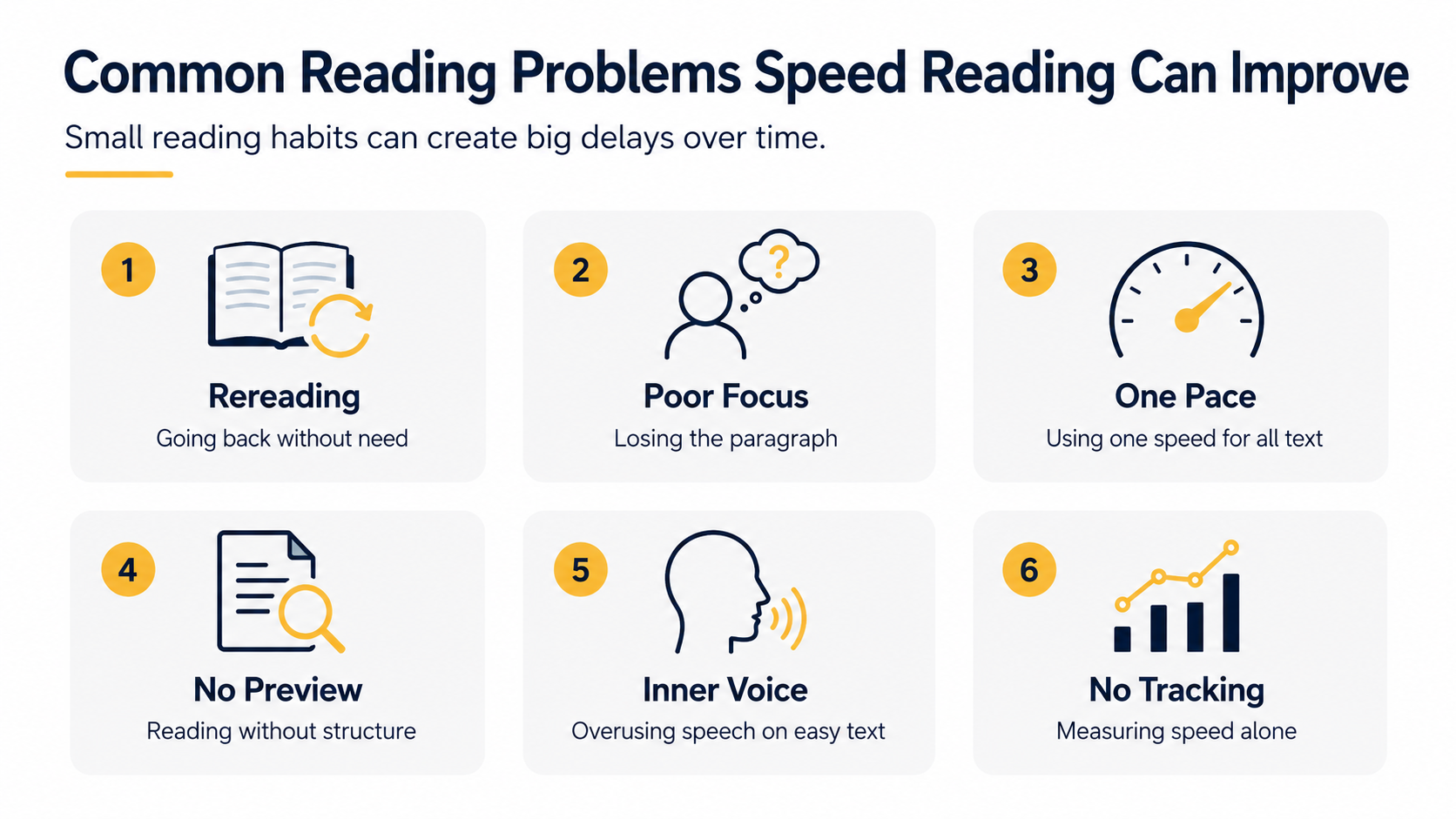
Common problems include:
• Rereading lines automatically
• Losing focus halfway through a paragraph
• Reading every type of text at one pace
• Starting without previewing the structure
• Depending too heavily on inner speech
• Measuring speed without checking comprehension
On their own, these habits may look small. Repeated across notes, reports, articles, and emails, they start to cost time.
Beyond speed, the three controls that matter most are:
Pace: how fast you move
Purpose: why you are reading
Comprehension: how well you understand
When these three work together, reading becomes more efficient.
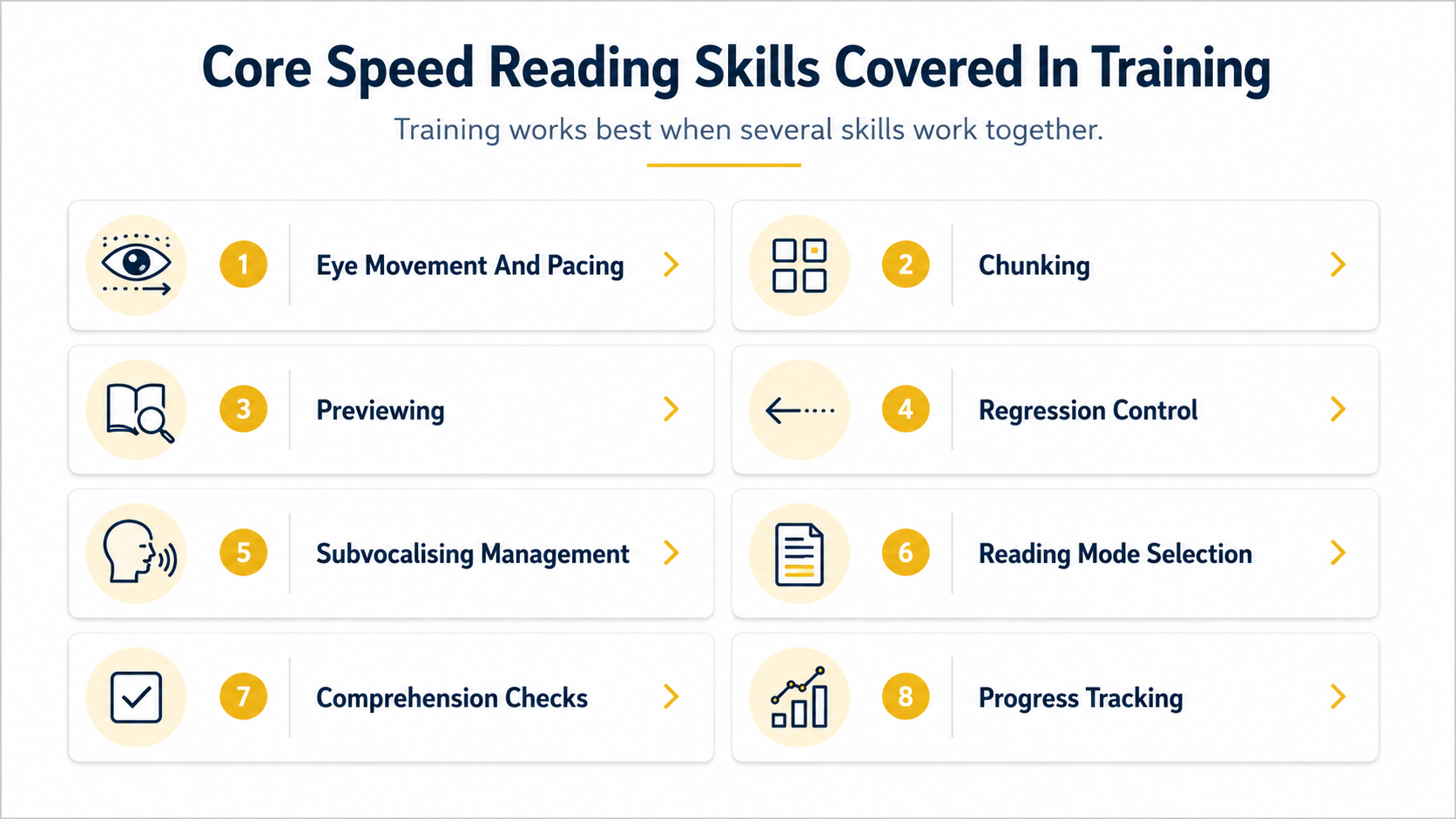
Most readers do not improve from one trick. They improve when pacing, previewing, comprehension checks, and reading mode selection work together.
Common speed reading skills include pacing, chunking, previewing, regression control, Subvocalising management and reading mode selection.
Pacing helps guide the eyes. Chunking helps readers process small groups of words. Previewing gives the brain context before full reading. Regression control reduces unnecessary rereading. Subvocalising management helps readers avoid overusing inner speech on simple material.
The most important skill is reading mode selection. Readers need to know when to skim, scan, speed read, or slow read.
Not every reader needs the same kind of training. Some only need a simple practice plan, while others need a full course or personal feedback.
A free app can help beginners test their current reading speed, practise simple drills, and build awareness of pace.
A short daily email sequence can help readers build one habit at a time. This works well when you want a simple start without feeling overwhelmed.
An online speed reading course gives a clearer path with lessons, practice, comprehension checks, and progress tracking.
Private coaching can help readers who need personal feedback or struggle with focus, confidence, or consistency.
Workshops can help students, teams, or professionals learn the same reading principles together and apply them to real study or work material.
For many readers, a short guided practice plan is enough to spot the habits slowing them down.
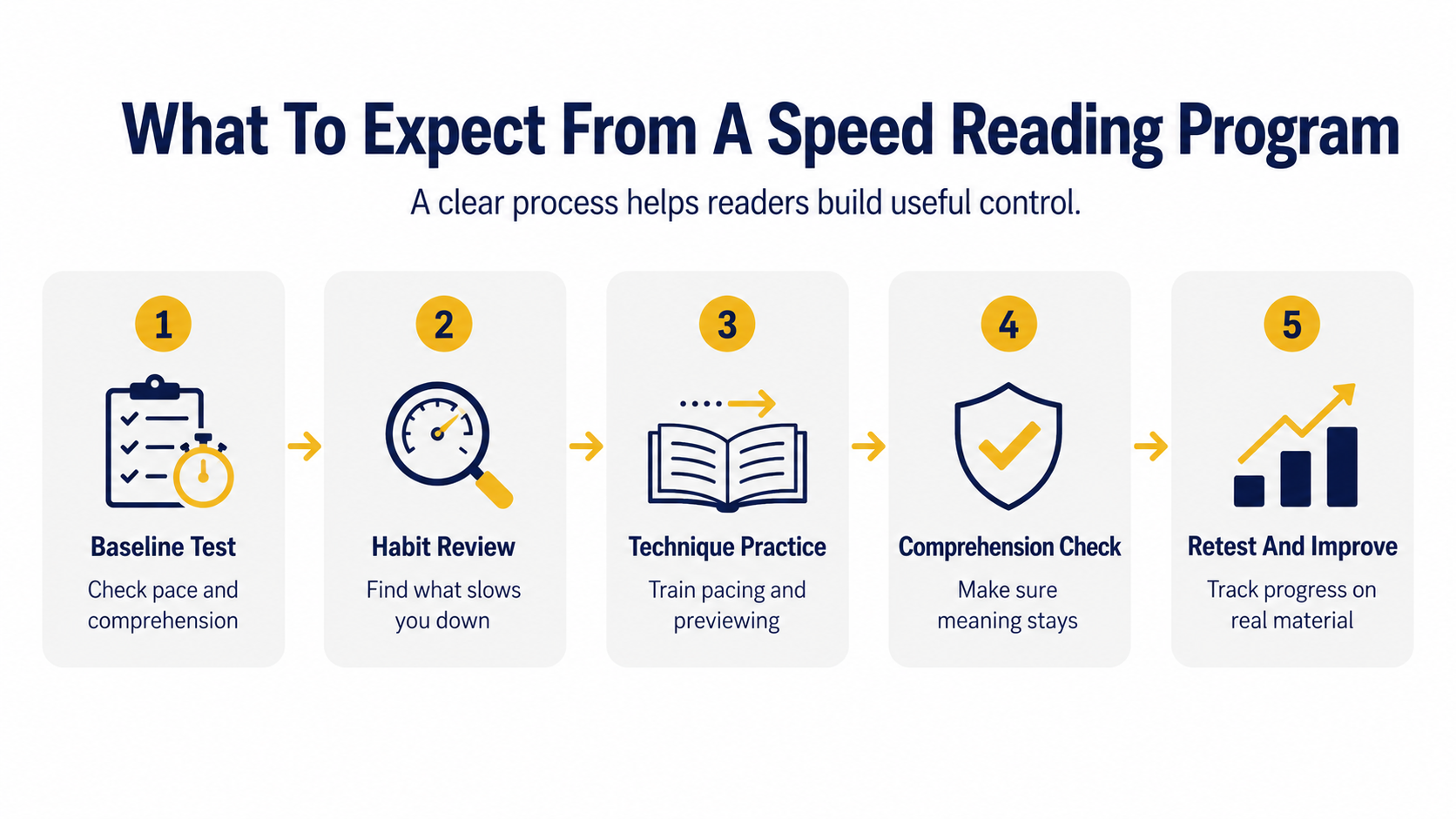
A useful speed reading program should start by showing you how you currently read.
It usually starts with a baseline reading test to check your current pace and comprehension.
Next, it reviews the habits that slow you down, such as rereading, poor focus, weak previewing, or using one pace for every text.
Then you practise techniques like pacing, chunking, previewing, regression control, and reading mode selection.
Comprehension checks should be included throughout. A good program should never reward speed if understanding drops too much.
Finally, you retest and apply the skills to real reading material such as notes, reports, articles, textbooks, or work documents.
Some readers notice small changes within a few days, especially in focus, pacing, and awareness of rereading.
Over the first week, a short daily practice plan can help readers spot wasted habits, test simple techniques, and understand which material suits faster reading.
Over two to four weeks, improvement can become more stable if practice is consistent and comprehension is checked.
You are not trying to use one fast speed for every text. You are learning when to move quickly and when to slow down.
Speed reading can help students manage notes, chapters, and revision material with less pressure.
It can help professionals process emails, reports, and research more efficiently.
It can help busy readers feel less overwhelmed by long articles, books, and learning material.
The real benefit is being able to change pace based on the task, instead of treating every text the same way.
Progress should include both reading speed and comprehension.
Track words per minute, but also check whether you can explain the main idea, remember the key points, and use what you read.
Compare similar text types when testing progress. A simple article and a dense academic chapter are not the same reading task.
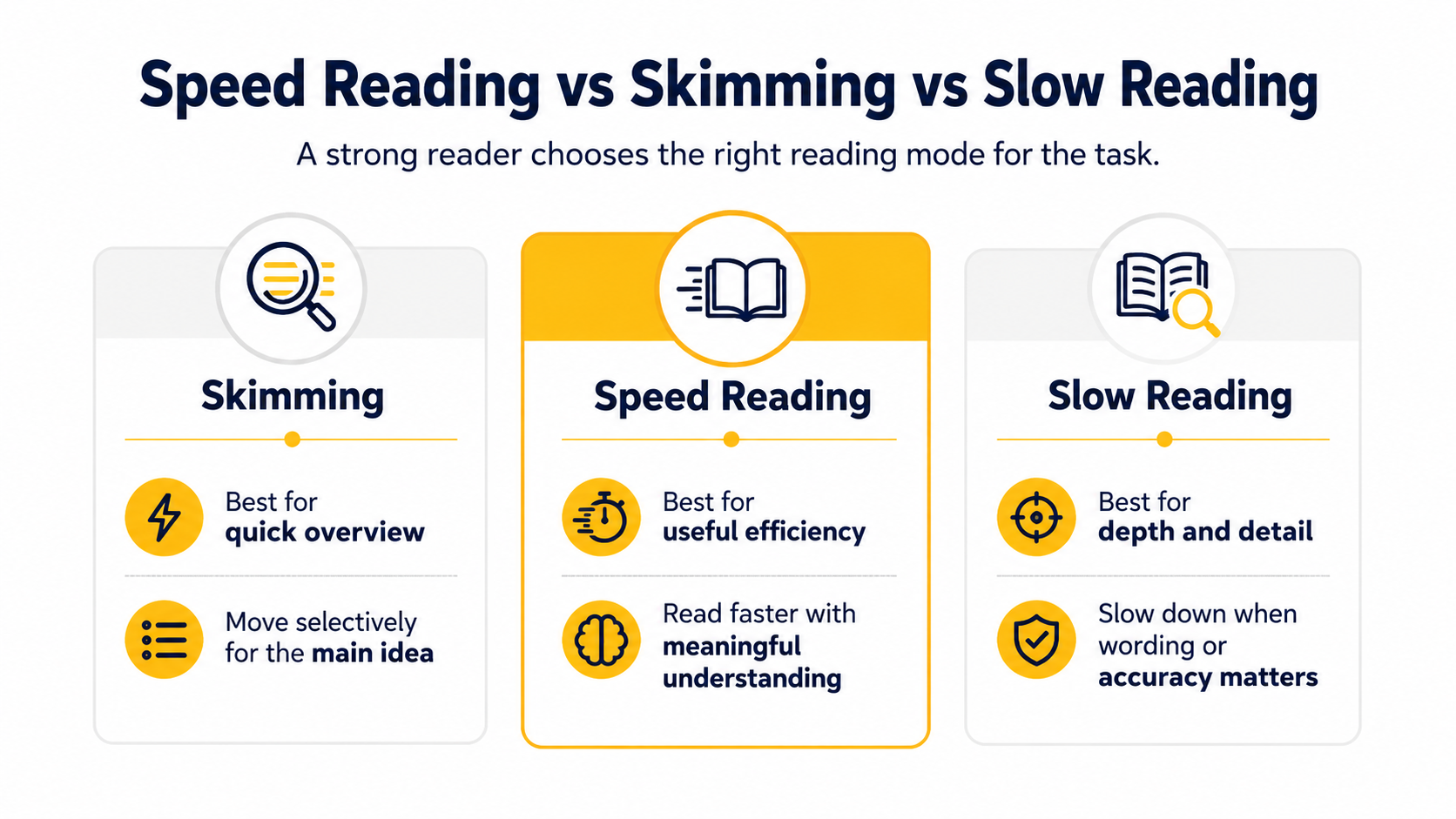
Speed reading, skimming, scanning, and slow reading are different reading modes.
Speed reading helps you read suitable material more efficiently while still following the meaning.
Skimming gives you the general idea. Scanning helps you find a specific detail. Slow reading is better when accuracy, depth, or nuance matters.
A strong reader does not rely on one mode. They choose the right one for the task.
Most weak speed reading advice fails because it focuses only on speed.
Some readers chase high words per minute and stop checking comprehension. Some try to use one fast pace for every task. Others believe they must remove subvocalising completely.
Real speed reading is not about extreme claims. It is about better habits, better pacing, better focus, and better reading decisions.
That is why slower reading still matters in some situations.
Do not speed read everything.
Slow down for legal, medical, technical, academic, financial, or detailed material where exact meaning matters.
Slow down for deep study, careful analysis, emotional writing, or anything that needs reflection.
If the wording matters, take your time.
A good speed reading course should be realistic. It should teach you how to read faster where it makes sense, but it should also explain when to slow down.
Look for training that includes comprehension checks, real reading practice, progress tracking, and clear guidance on different reading modes.
Be careful with any course that promises extreme results on every type of text. Also be careful if the training only talks about words per minute and ignores understanding.
A good course should leave you with better reading judgment, not just a higher test number.
Speed reading is not a superpower. It is a practical way to read suitable material faster without losing the meaning you need.
Strong readers are flexible. A report summary does not need the same pace as a contract clause or a difficult textbook explanation.
If slow rereading, poor focus, or one-speed reading is holding you back, start with guided practice. StudyFast’s free training and Speed Reading Mastery course can help you test your current pace, build better habits, and improve step by step.
Speed reading is the practice of reading faster while keeping enough understanding to make the reading useful.
Yes, in realistic forms. It can help readers move through suitable material more efficiently, but it does not work the same way for every type of text.
No. Skimming gives you the general idea. Speed reading aims to read more efficiently while still understanding the text.
Yes, within limits. The aim is to improve efficiency without dropping the level of understanding needed for the task.
Students, professionals, exam candidates, and busy readers benefit most when they need to manage a high volume of reading.
Slow down for technical, legal, medical, academic, financial, or detailed material where exact meaning matters.
A good course should include realistic practice, comprehension checks, progress tracking, and guidance on when to speed up or slow down.