

Speed reading has been marketed as a life-changing skill for decades. Claims about reading a book in an hour, tripling your words per minute, or processing text at extreme speeds are common in courses, apps, and self-help content.
That is why many people are rightly sceptical.
The honest answer is this: speed reading works in a realistic form, but not in the exaggerated way it is often sold.
Some reading habits can improve with practice. Some techniques can help readers move through suitable material more efficiently. But claims about extreme speed with full comprehension usually ignore how reading works.
For the broader overview of the skill itself, read our guide on what speed reading is.
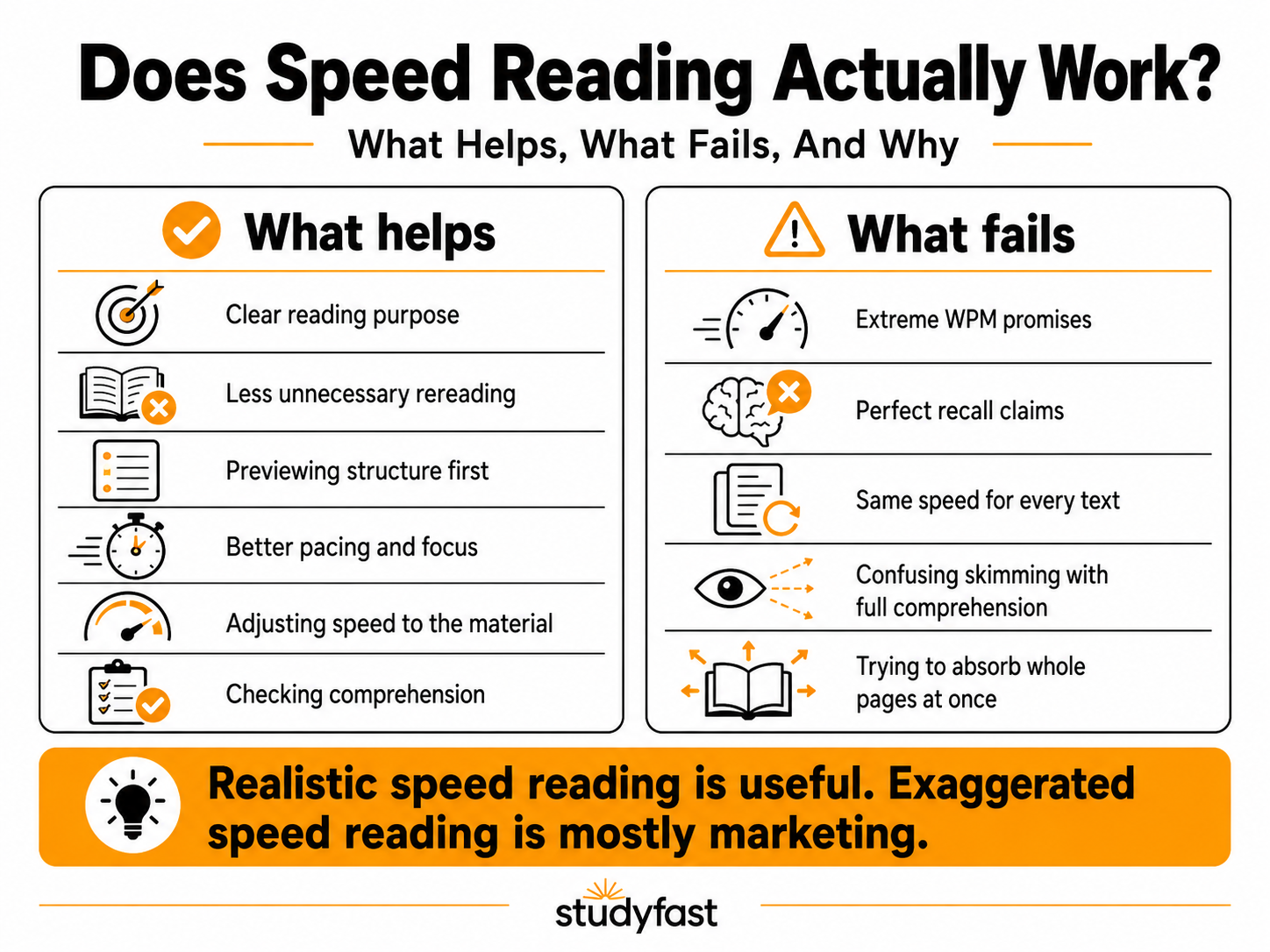
Speed reading does work when it means improving reading efficiency, focus, pacing, and comprehension control on suitable material.
It does not work when it promises extreme words per minute, perfect recall, or the same fast pace across every type of text.
The realistic version is useful. The exaggerated version is mostly marketing.
{{EMBED}}
Before judging speed reading, the question needs to be clear.
If “work” means reading at 1,000 words per minute or more while fully understanding and remembering everything, that is not realistic for most readers.
Reading is not only eye movement. The brain has to recognise words, connect meaning, follow structure, hold information in working memory, and decide what matters. Those processes take time.
But if “work” means improving your reading rate on suitable material while keeping enough comprehension for the task, then yes, speed reading can work.
That is the difference between a realistic skill and an unrealistic promise.
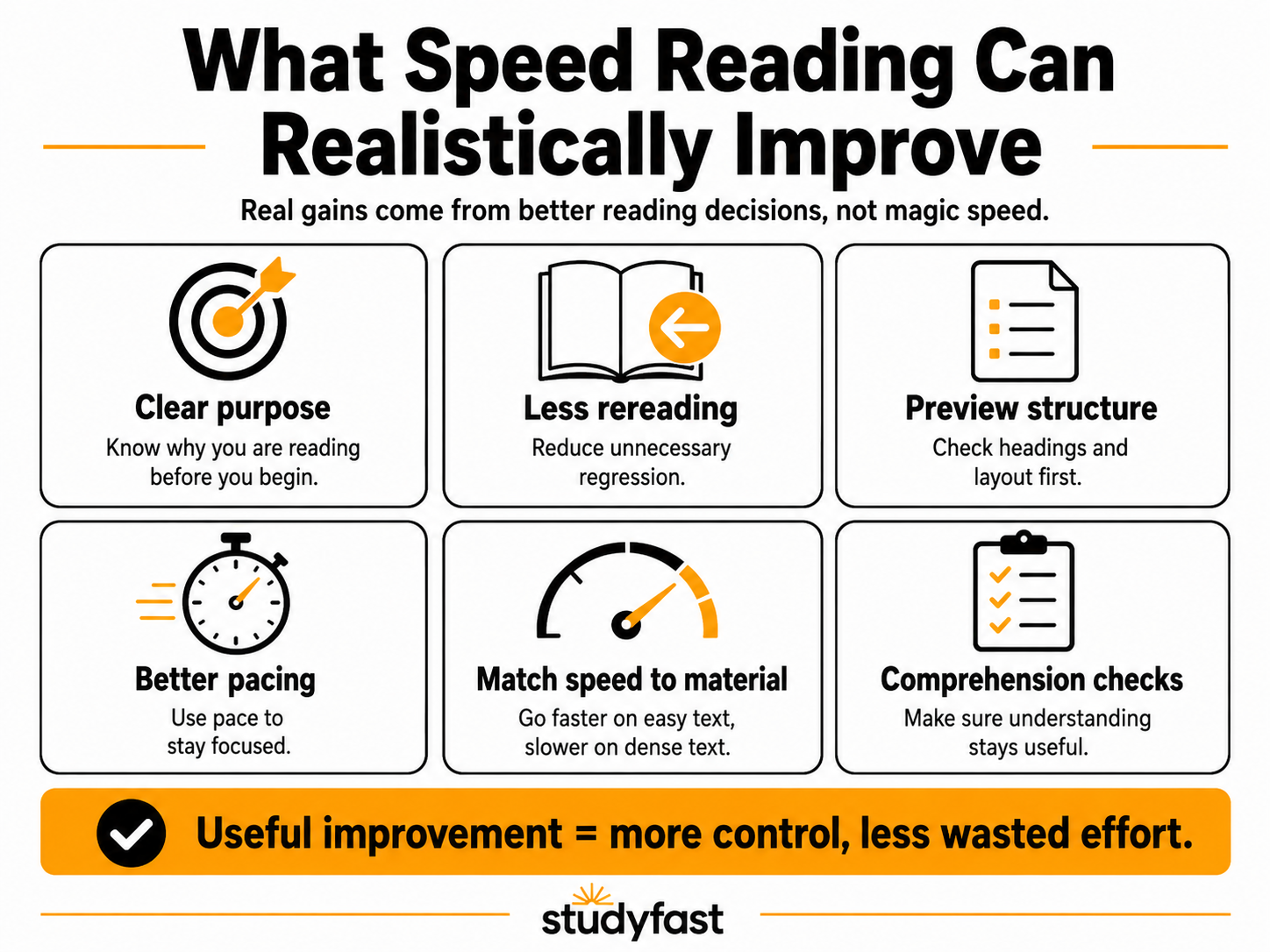
Speed reading is most useful when it improves inefficient reading habits.
Many readers lose time because they reread lines automatically, drift in and out of focus, start without previewing, or use the same slow pace for every type of text.
A good speed reading approach helps readers become more aware of these habits and replace them with better reading decisions.
The realistic improvements usually come from:
These changes are not dramatic in the way some marketing promises. But they can make reading feel more controlled, less wasteful, and more efficient.
Speed reading claims become weak when they promise results that reading cannot realistically support.
The first problem is extreme WPM. Moving through text several times faster than a normal reading pace usually reduces understanding. The reader may still see the words, but the meaning is not processed deeply enough.
The second problem is the idea that peripheral vision can absorb full lines or pages at once. Peripheral vision can support awareness around the point of focus, but it cannot replace meaningful word and phrase processing.
The third problem is confusion with skimming. A person may move through a page quickly and understand the general idea, but that is not the same as reading the full text with strong comprehension.
For that distinction, see our guide on speed reading vs skimming.
Speed and comprehension are connected.
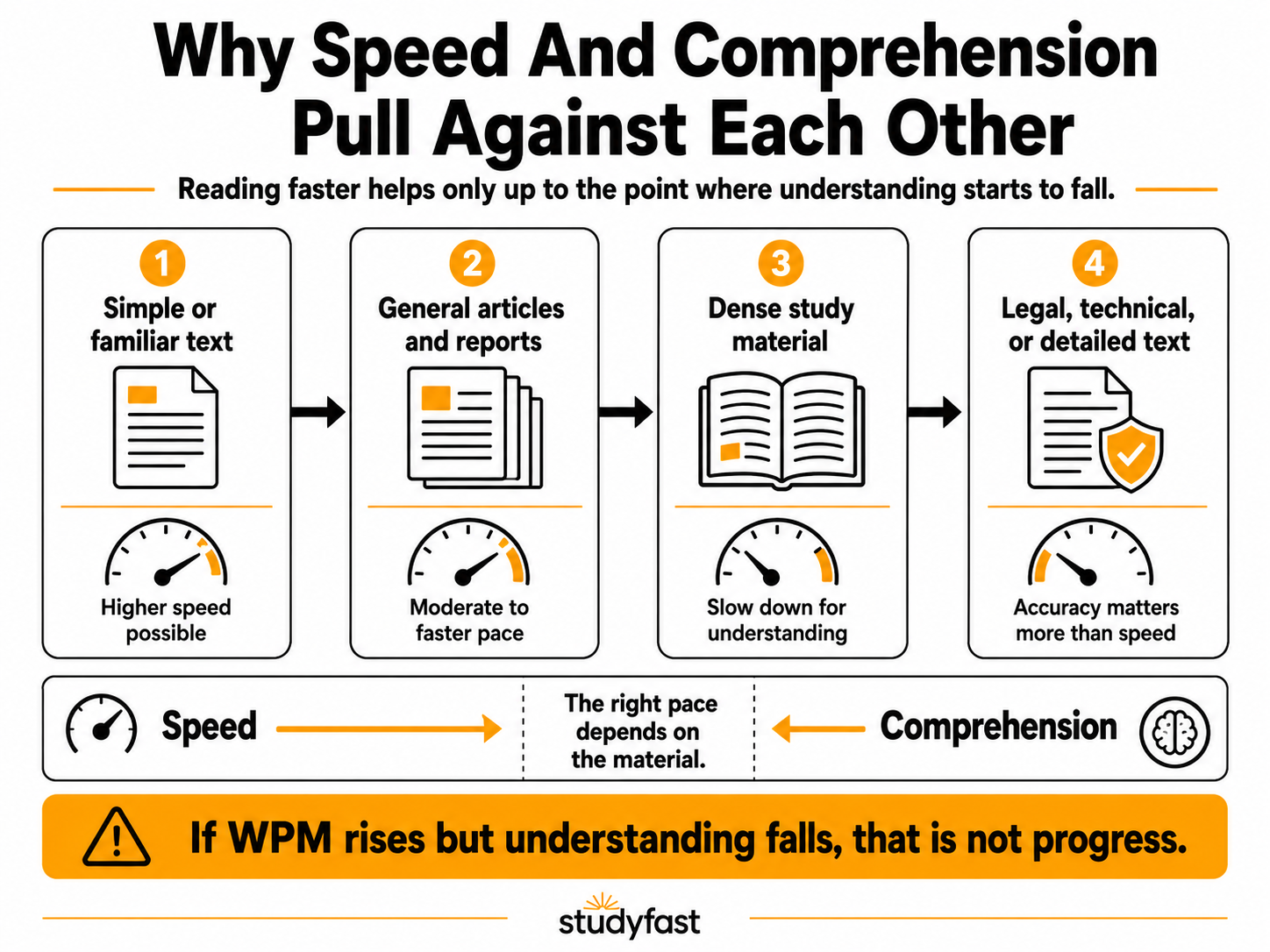
Reading faster can be helpful up to a point. Beyond that point, the brain has less time to process meaning, connect ideas, and remember what was read.
The limit depends on the reader and the material.
Simple, familiar writing can usually be read faster. Dense academic, legal, technical, medical, or unfamiliar material needs more time. A short article and a complex textbook chapter should not be judged by the same speed target.
This is why words per minute should never be measured alone. If your WPM rises but your understanding falls, that is not real progress.
Our guide to what makes a good reading speed explains how to think about WPM benchmarks without ignoring comprehension.
The most useful part of speed reading is not forcing the eyes to move faster. It is learning how to read with better control.
Most readers improve when they stop treating every text the same way. A work email, a report summary, a textbook explanation, and a legal clause all need different levels of attention.
Practical speed reading focuses on choosing the right approach before and during reading.
For example, a reader might skim a long article first to understand the structure, then speed read the useful sections, then slow down for the part that contains important detail.
This is much more realistic than trying to apply one fast pace to everything.
For practical methods, read our guide on which techniques help increase reading speed.
Speed reading does not turn difficult material into easy material.
It does not replace careful study, close analysis, or slow reading when exact meaning matters. It also does not guarantee perfect recall, because memory depends on attention, understanding, repetition, and the purpose of the reading task.
It does not make legal, technical, academic, financial, or medical content suitable for a fast pace in every situation.
This matters because strong reading is not about using speed all the time. It is about knowing when speed helps and when it becomes risky.
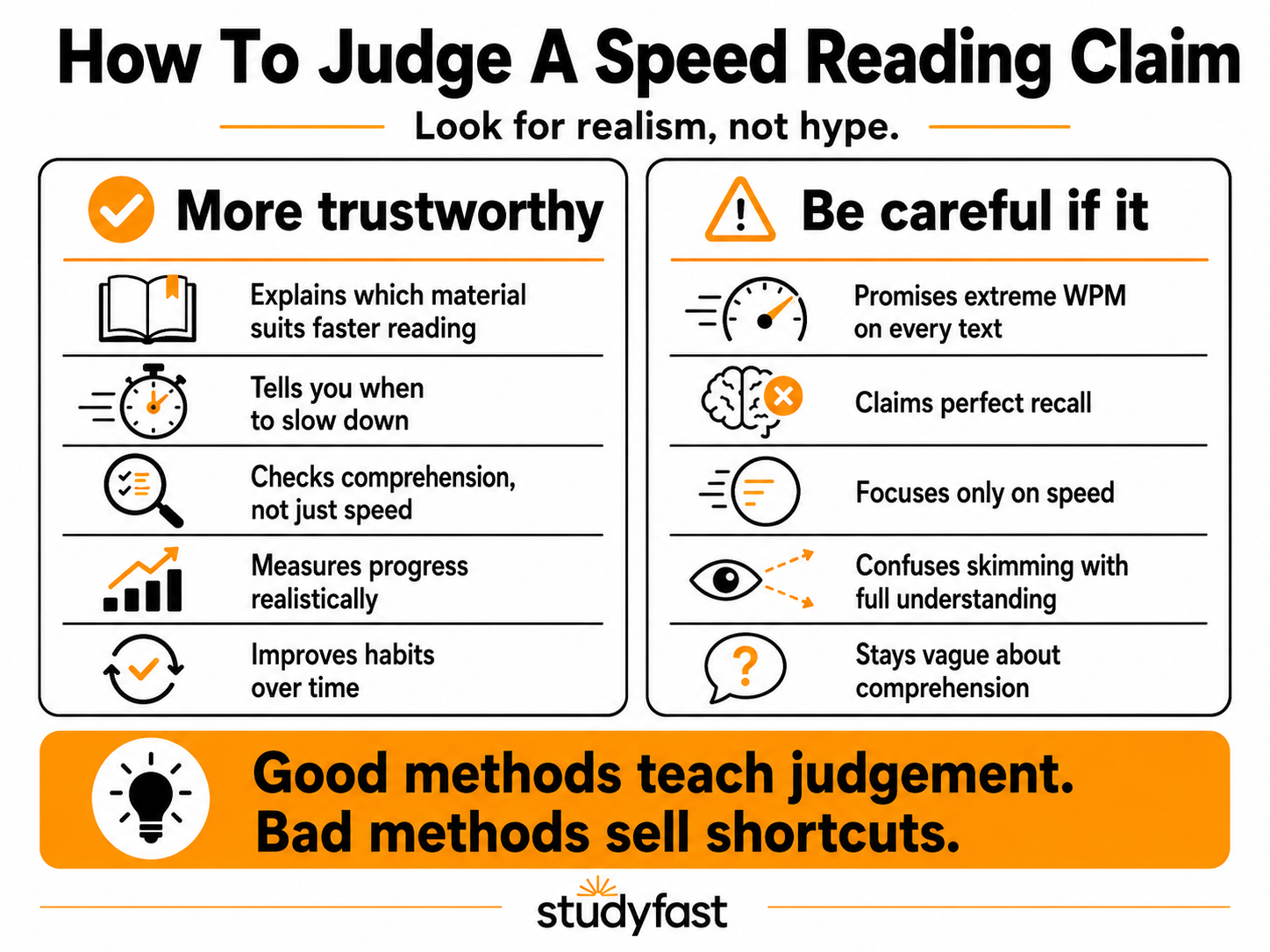
A good speed reading claim should be realistic.
Be careful with any course, app, or method that promises extreme WPM increases on every type of text. Also be careful if it talks only about speed and does not measure comprehension.
A more trustworthy approach will explain:
If the method cannot explain the difference between efficiency and raw speed, the claim is probably too vague.
Yes, when it is used realistically.
Speed reading can help readers become faster and more efficient on suitable material. It can reduce wasted rereading, improve focus, and help readers choose a better pace for the task.
No, when it is sold as a way to read anything at extreme speed with full comprehension.
The honest version is useful. The exaggerated version creates the wrong expectation.
Speed reading works best as a reading efficiency skill, not as a shortcut around comprehension.
The goal is not to force every text into one fast pace. The goal is to read with better judgement: speed up when the material allows it, slow down when detail matters, and keep checking whether you understand what you read.
That kind of improvement is realistic and valuable.
If slow reading habits, weak focus, or poor pacing are holding you back, StudyFast’s Speed Reading Mastery course can help you build a more structured approach to reading faster without ignoring comprehension.
Yes, in realistic forms. It can help readers improve efficiency, focus, and pace on suitable material. Extreme claims about very high speeds with full comprehension are less reliable.
Moderate improvement through better reading habits is realistic. Dramatic claims about reading at extreme speeds with perfect comprehension are not well supported.
Yes, within limits. The aim is to increase speed while keeping enough understanding for the task. If comprehension drops too much, the reading has not improved.
Because they often focus on words per minute without explaining comprehension, memory, text difficulty, or the natural limits of language processing.
The most useful parts are reducing unnecessary rereading, improving focus, previewing structure, using pacing, and matching speed to the material.
No. Skimming is selective reading for the main idea. Speed reading aims to move through more of the full text efficiently while still following the meaning.
Do not speed read material where exact meaning matters, such as legal, medical, technical, academic, financial, or highly detailed text.