

You finish a book, feel like you understood it, and a week later you can barely recall a single idea from it. That is not a reading problem. It is a retention problem — and it is fixable.
Most people assume a poor memory is something you are born with. In reality, how much you remember depends far more on how you read than on any fixed ability — and the habits below let you read quickly and still remember well.
To remember what you read, you have to move information from short-term into long-term memory through active engagement: read with a question in mind, recall each section from memory instead of rereading it, and review at spaced intervals. Passive reading fades within days. Active reading, reviewed on a schedule, is what makes it stick.
You will not remember everything, and you do not need to. The goal is to keep the ideas that matter and be able to use them when you need them.
{{EMBED}}
Forgetting is not a flaw. It is your brain's default. Over a century ago the psychologist Hermann Ebbinghaus mapped what is now called the forgetting curve: without review, we lose a large share of new information within the first 24 hours, and most of it within a week. Your brain treats anything it does not revisit as unimportant and quietly clears it out.
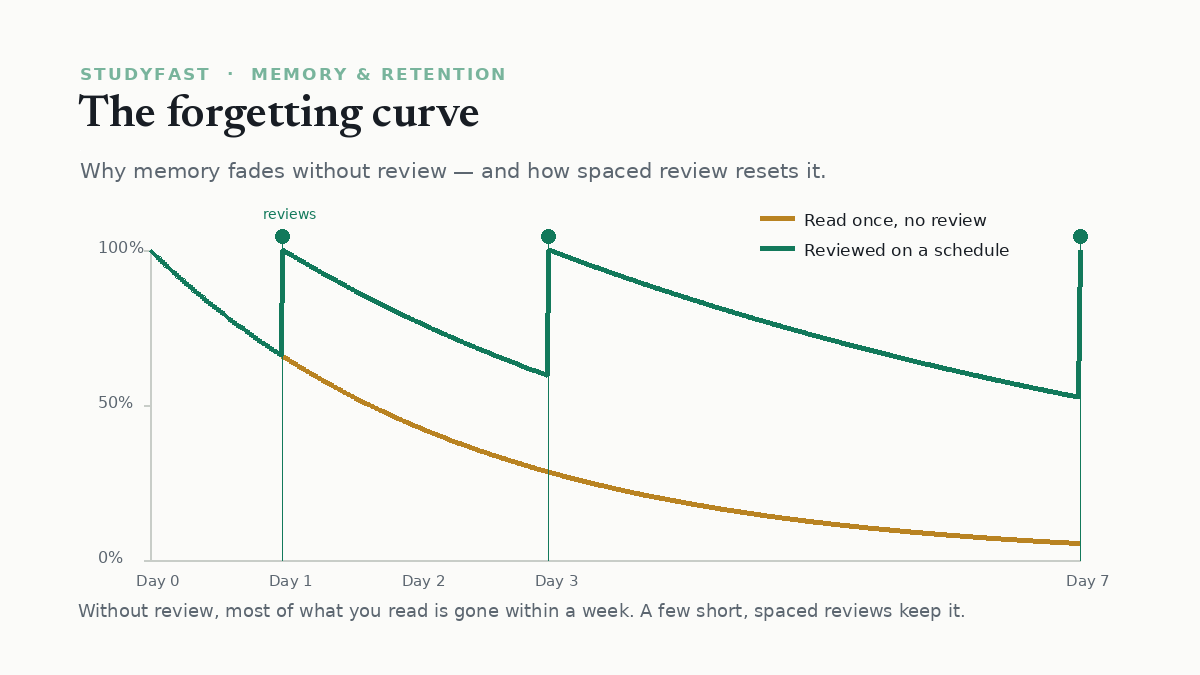
Three habits make this worse:
The fix is to read actively and to review on purpose. Every technique below is a version of those two ideas.
What you do in the sixty seconds before you start reading has an outsized effect on what you keep. Decide why you are reading and what you want to walk away with. A reader looking for one specific argument reads — and remembers — very differently from someone drifting through the pages.
Then preview the material: skim the headings, the first line of each section, and the summary. This primes your brain with a mental map, so new details have somewhere to attach. This is the same previewing skill that underpins efficient reading — if you want the full method, see our guide on what speed reading is and how it works.
You do not need all eight at once. Pick two or three that fit what you are reading, and build from there.
Before each chapter or section, turn the heading into a question you want answered. Instead of passively reading "the causes of the 2008 crisis," you are actively hunting for "what actually caused the 2008 crisis?" Your brain pays far more attention to information it is actively looking for, and attention is the gateway to memory.
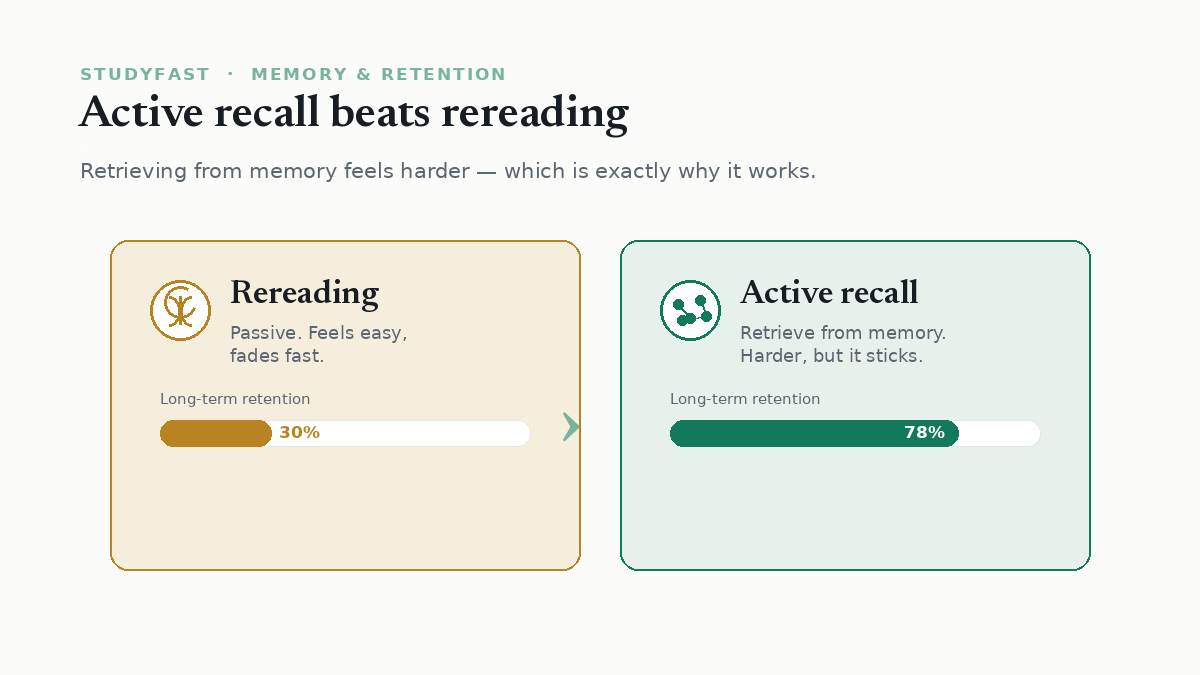
This is the single most powerful retention habit there is. At the end of a section, look away from the page and try to recall the main points from memory. It feels harder than rereading — and that difficulty is exactly why it works. Every act of retrieval strengthens the memory, while rereading mostly strengthens the comfortable illusion that you already know it.
After a chapter, close the book and write a short summary in your own words on a blank page — no peeking. Putting ideas into your own language forces you to process them, not just recognise them, and instantly exposes the parts you did not really understand. Those gaps are where your next read should focus.
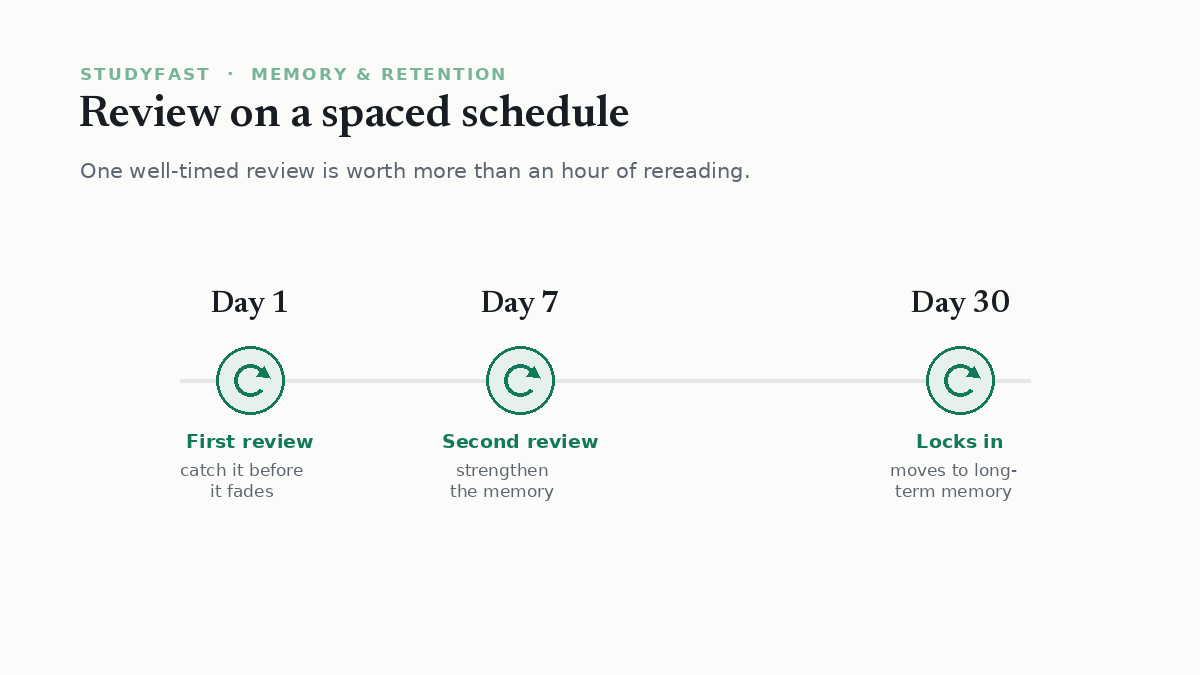
One review is worth more than any amount of rereading in a single sitting. To beat the forgetting curve, revisit your notes at expanding intervals — roughly after one day, then one week, then one month. This is spaced repetition, and it is how information moves into durable long-term memory. Five minutes of review at the right moment saves you rereading the whole chapter later.
Isolated facts are hard to hold; connected ideas are easy. As you read, deliberately link each new concept to something you already understand — an example from your own work, a related idea from another book, a personal experience. This is called elaboration, and every link you build gives your memory another route back to the information.
Your brain remembers images far better than abstract words. When something matters, pause and picture it — the stranger and more exaggerated, the better. To remember ordered material, place those images along a familiar route through your home; this is the memory palace, the same method of loci that world memory champions use to memorise decks of cards and long lists. It sounds unusual, but it is trainable and remarkably effective.
If you can explain an idea simply, in plain language, you genuinely understand it. If you stumble, you have found a gap. Explaining what you read — to a colleague, a friend, or even out loud to yourself — is one of the fastest ways to both test and cement understanding. Aim to explain it as if to someone with no background in the subject.
More highlighting does not mean more retention — it often means less, because highlighting is passive. Instead, capture only the ideas worth keeping, in your own words, and note why each one matters or how you might use it. A handful of well-chosen, personally meaningful notes beats a book drowning in yellow ink.
People often assume that reading faster must hurt memory. Done badly, it can — racing through dense material at one flat pace damages both comprehension and recall. Done well, speed and retention support each other.
The key is matching your pace to your purpose. Most of what lands in front of us — routine emails, familiar reports, background articles — does not deserve slow, careful reading. Moving through that material efficiently frees up time and mental energy for the reading that genuinely matters, where you apply the retention techniques above. If you are worried speed will cost you understanding, our guide on how to improve reading speed without losing comprehension breaks down exactly how to protect it.
Set an honest expectation: no one remembers everything they read, and you do not need to. Even memory champions do not retain 100% of a book. The goal is not total recall — it is keeping the ideas that matter and being able to use them when you need them.
A realistic target is to walk away from a book able to explain its central argument, recall a handful of key ideas, and know where to look for the detail. Applied consistently, the techniques above will take you from remembering a vague impression to holding the ideas you actually care about.
A simple system beats a long list of tactics you never use. For anything you want to remember, try this loop: set a purpose before you read, recall after each section, write a short summary at the end, and review once the next day and again the following week. That is the whole system. It adds a few minutes to your reading, and it is the difference between forgetting a book by Friday and still using its ideas months later.
Remembering what you read is a skill, not a gift. The readers who retain the most are not the ones with the best memories — they are the ones who read actively and review on purpose.
If you want a proven system rather than a handful of tips, StudyFast's Memory Mastery course teaches the same techniques used by world memory champions, applied to real life — reports, meetings, books and lectures. Start with the free 7-day training to test where your memory is now, or pair it with speed reading in the discounted bundle and read faster while keeping what you read.
Usually because the reading was passive. If you read without setting a purpose, recalling the material, or reviewing it, your brain treats the information as unimportant and clears it within days, following the forgetting curve.
Active recall — closing the book and retrieving the main points from memory instead of rereading. Combined with spaced review over the following days, it is the most effective, best-evidenced retention method there is.
Not when it is done properly. Reading everything at one fast pace hurts retention, but matching your speed to the material — fast for routine text, slow for what matters — actually improves it by protecting your attention for the important reading.
Test yourself instead of rereading. Use active recall and spaced repetition: review each topic after a day, a week, and a month, and practise retrieving answers from memory rather than recognising them on the page.
Yes. Memory is trainable. Techniques such as visualisation, the memory palace, and spaced review reliably improve how much people retain, regardless of their starting point — which is the basis of formal memory training.
Many people notice a difference within a week of applying active recall and spaced review consistently. Deeper skills like the memory palace become more powerful over a few weeks of practice.