

Students read more than they realise.
Textbooks, lecture notes, research papers, revision guides, slides, assignments, and exam material all depend on reading. When reading feels slow, studying feels heavier too.
Speed reading can help students, but only when it is used as a study tool, not as a shortcut.
The goal is not to rush through every textbook or skip important details. The goal is to read suitable material more efficiently, stay focused for longer, and know when to slow down for deeper understanding.
Good student reading is not just about speed. It is about choosing the right pace for the right study task.
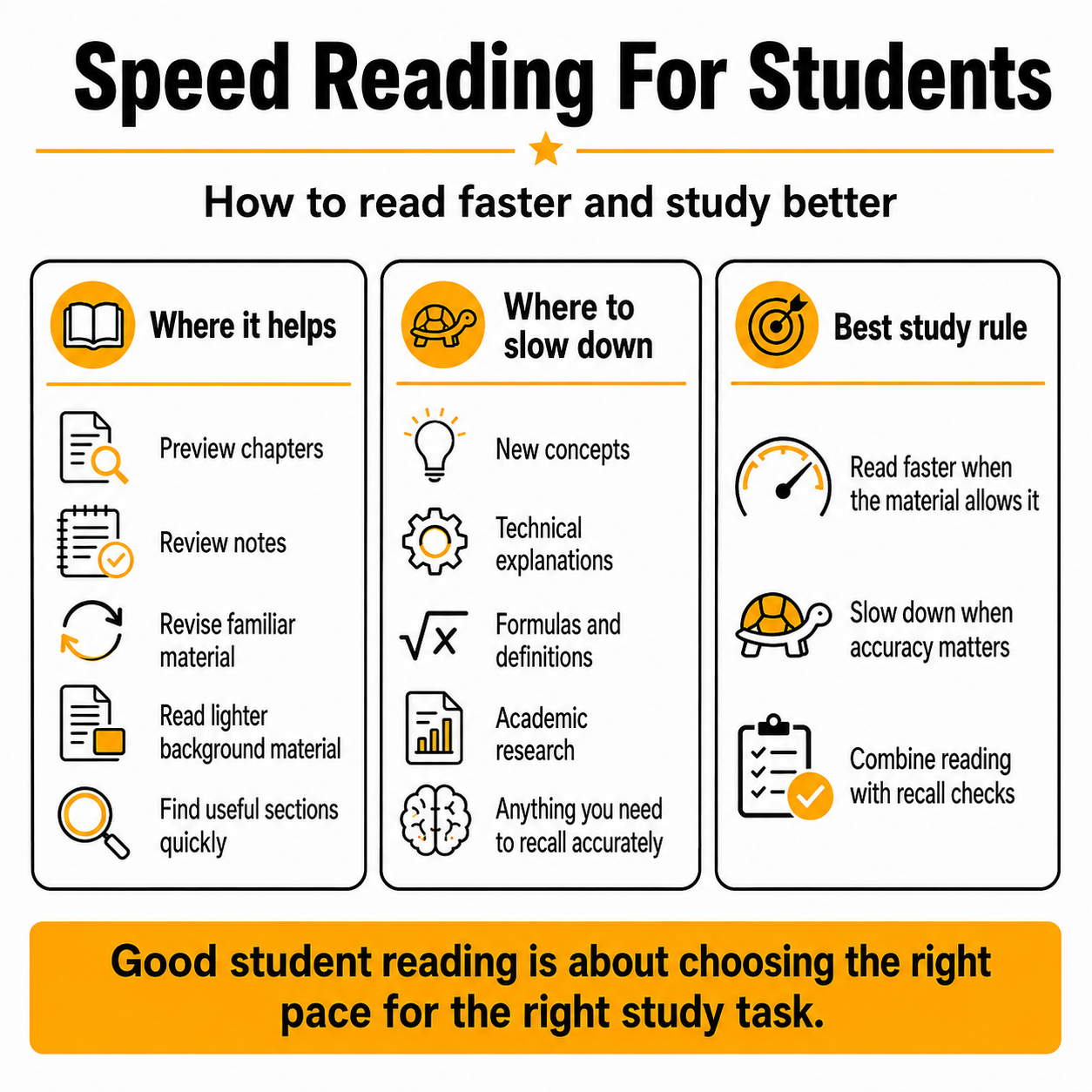
Speed reading can help students read faster and study better when it is used for previewing chapters, reviewing notes, revising familiar material, and moving through lighter reading tasks.
Students should slow down for complex topics, technical explanations, formulas, definitions, academic arguments, and anything they need to remember accurately for an exam. The safest approach is to combine faster reading with focus, active recall, and comprehension checks.
{{EMBED}}
Yes, students can use speed reading for studying, but not for every type of study task.
Before using it for studying, it helps to understand what speed reading is and where it fits into the reading process.
Speed reading is useful when you need to:
It is less useful when you need to:
This is where many students get speed reading wrong. They try to read everything faster, then comprehension drops.
A better approach is to use speed reading as one study tool, not as the only way to read.
Many students are not slow because they lack ability. They are slow because their reading habits are not trained for study workload.
Common problems include:
These habits make studying take longer than it needs to.
The problem is not always the amount of reading. Sometimes the problem is how the reading is being handled.
Speed reading helps most when the material is suitable and the purpose is clear.
Before a lecture, you may not need to understand every detail. You may only need a basic idea of the topic.
In this case, speed reading can help you preview headings, key terms, diagrams, summaries, and main sections. This gives your brain a map before the lecture starts.
After class, speed reading can help you move through notes and identify what needs more attention.
You can read faster through familiar points and slow down when something looks unclear.
Revision is one of the best times to use faster reading.
If you have already studied the topic, you do not need to read every sentence as if it is new. You can move faster through familiar sections and spend more time testing recall.
Some reading is useful but not central.
For example, a background article may help you understand a topic, but it may not need the same attention as your main textbook. Speed reading can help you get the value without spending too much time.
Students often need to search through long material to find relevant information.
In this case, moving efficiently through headings, introductions, topic sentences, and summaries can save time.
Speed reading should not be used everywhere.
Students should slow down when reading:
If the material is difficult, slow reading is not a weakness. It is the correct strategy.
Strong students know when to move quickly and when to read carefully.
Textbooks are not meant to be read like novels.
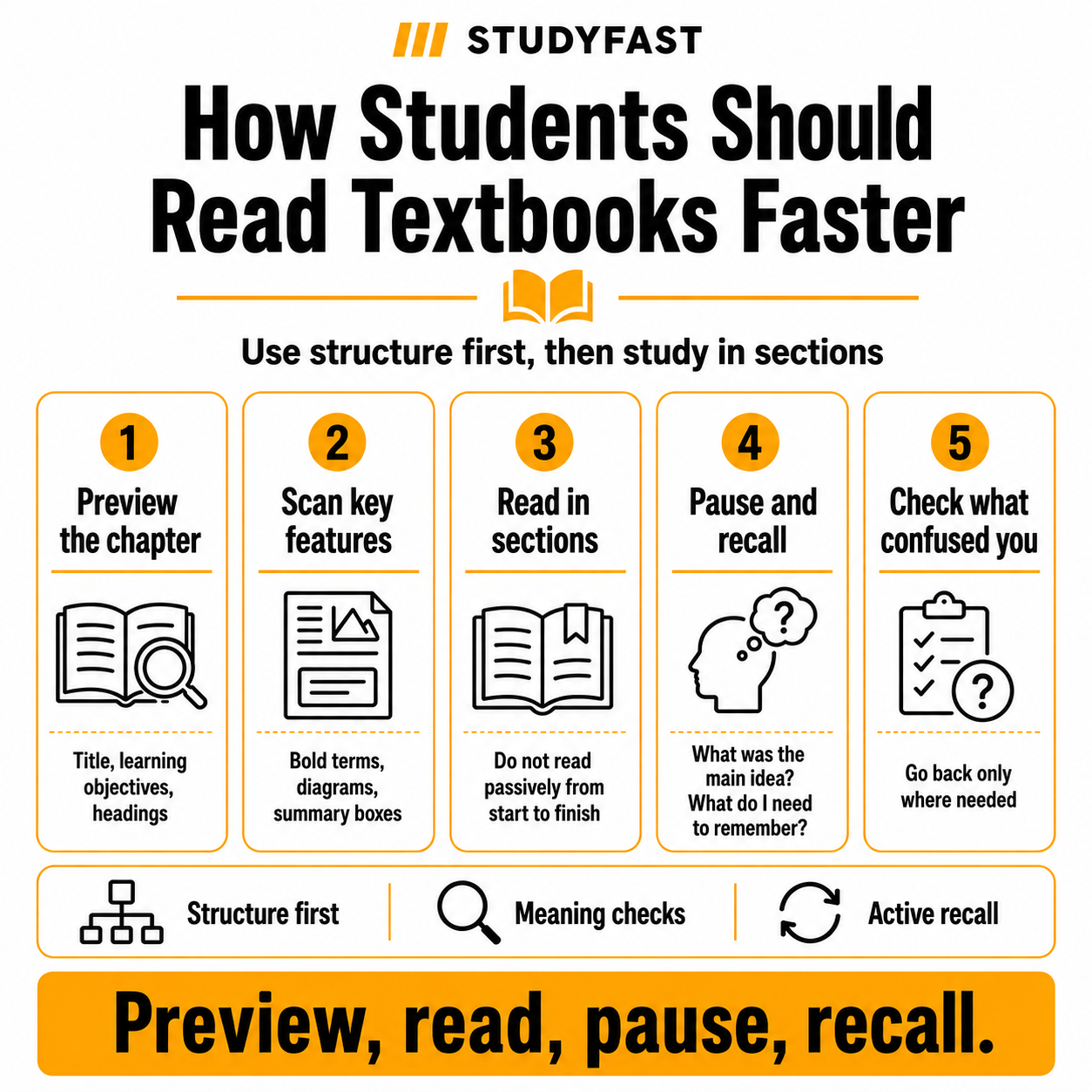
A textbook chapter usually has structure. You can use that structure before reading every line.
Before reading a chapter, look at:
This preview helps you understand what the chapter is about before you start reading properly.
Then read the chapter in sections.
After each section, pause and ask:
This approach is faster than reading passively from start to finish and then realising you remember very little.
Study notes should be easier to read than textbooks because they are usually shorter and more familiar.
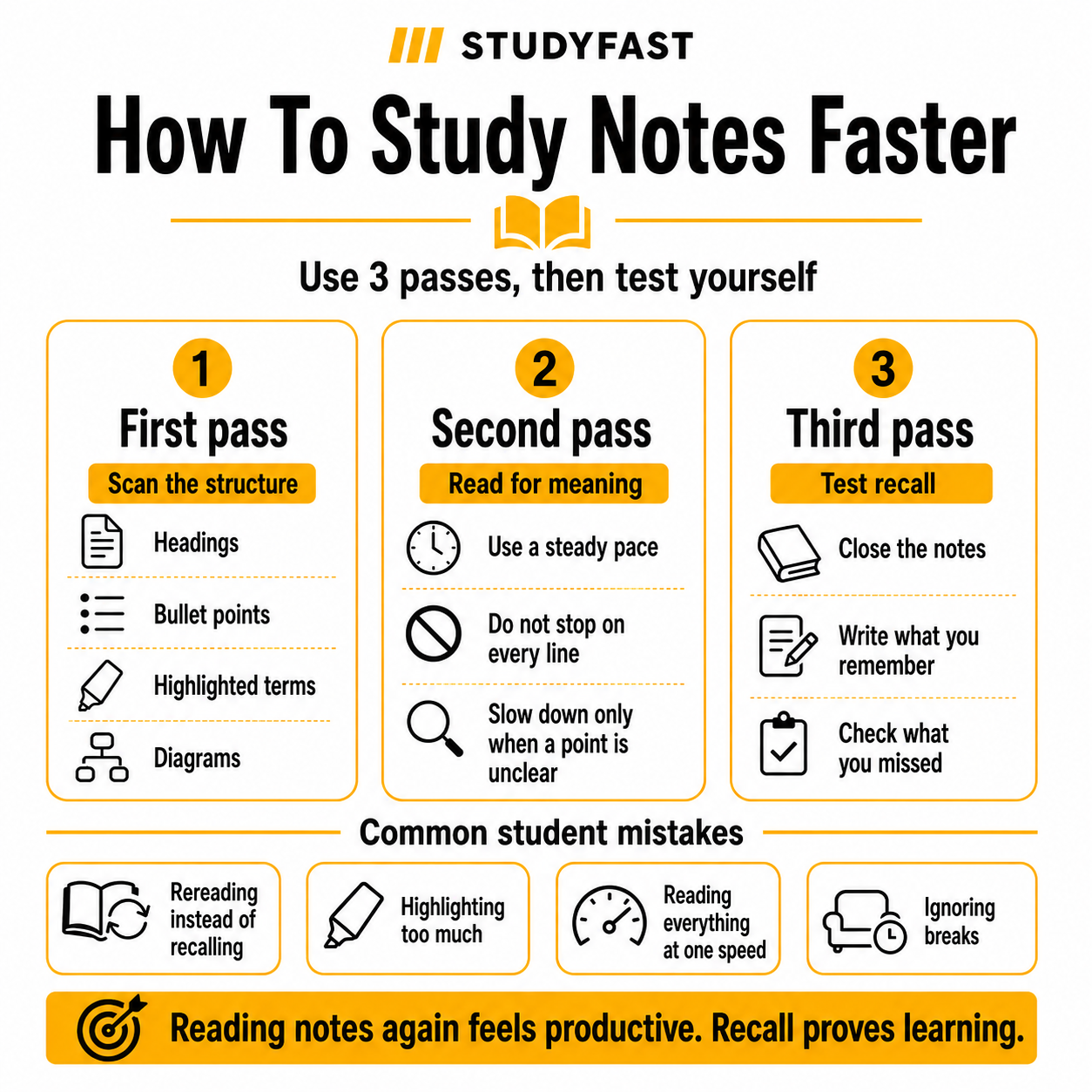
Use speed reading on notes in three passes.
Look at headings, bullet points, highlighted terms, and diagrams. This helps you remember what the notes cover.
Read through the notes at a steady pace. Do not stop on every line unless the point is unclear.
Close the notes and write down what you remember.
This is important because reading notes again and again can feel productive, but it does not always mean you are learning. Recall shows whether the information is actually staying.
Revision should not be only rereading.
Many students spend hours looking over notes, but they do not test themselves enough. This can create a false sense of progress.
A better revision method is:
Speed reading helps with the first two steps. Active recall helps with learning.
This balance matters because exam success depends on remembering and applying information, not just seeing it again.
Academic articles can be difficult because they are dense and often written in a formal style.
Do not start by reading every word from the first sentence.
A better order is:
This helps you understand the article’s purpose before going into detail.
For academic reading, speed reading should be used for orientation first. Careful reading should be used for the parts that matter most.
Reading speed depends heavily on focus.
If your attention keeps breaking, you will keep going back over the same lines. That makes reading slower and more frustrating.
Before a reading session:
A 20 minute focused reading session is usually better than an hour of distracted reading.
Students often blame memory or reading speed when the real issue is attention.
Many students lose time because they keep going back over sentences.
Sometimes this is useful. If a sentence is complex or important, rereading can help.
The problem is unnecessary rereading, also known as regression in reading.
This happens when your eyes move backwards out of habit rather than need. It can break reading flow and make studying feel much slower.
To reduce it, finish the paragraph first. Then pause and ask what the paragraph meant. If you understand the main idea, continue. If not, reread with a clear purpose.
Many students hear an inner voice while reading, which is often described as subvocalising while reading.
This is normal. It can even help when the material is difficult or important.
But if you mentally say every word at full speaking speed, reading can become slower than it needs to be. This is especially noticeable with easier study material.
The goal is not to remove the inner voice completely. The goal is to reduce it when the text is simple enough and use it when accuracy matters.
For example, you may read a familiar paragraph faster by focusing on meaning rather than mentally pronouncing every word. But you may slow down and use inner speech for definitions, formulas, or important exam points.
Speed reading is only useful for students if comprehension stays strong.
After reading a section, ask yourself:
This turns reading into active study.
A simple rule works well:
If you cannot explain it, you have not finished studying it.
Reading faster may help you cover more material, but recall and understanding decide whether the reading was useful.
Not every text deserves the same pace.
Easy notes can be read faster. New or complex topics need slower reading.
Highlighting feels useful, but it can become passive.
Only highlight after you understand the point. Then test whether you can remember it without looking.
Rereading is easier than recall, but recall is usually better for learning.
Close the book and test yourself.
Start with easier material. Build control first. Then apply the skill to harder texts slowly.
Tired reading is slow reading.
Short breaks help focus, especially during long study sessions.
Read a normal study page for 5 minutes. Write down the main points from memory.
Before reading a textbook section, look at headings, bold terms, and summary points.
Use your finger or cursor to guide your eyes through easier material.
Practise reading small groups of words instead of stopping on every word.
Finish each paragraph before deciding whether to go back.
After reading a section, close the material and write the main idea from memory.
Read similar material again and compare speed, focus, and comprehension.
The aim is not to rush study. The aim is to build better reading control.
Speed reading can help students, but it should be used with care.
It works best for previewing, reviewing, revising, reading familiar material, and moving through lighter study content. It should not replace slow reading when the material is complex, technical, or important for exams.
The best student readers are flexible. They know when to read quickly, when to slow down, when to test recall, and when to go back with a clear purpose.
If you want a structured way to practise these skills, the Speed Reading Mastery course gives students guided exercises for pace, focus, and comprehension control.
Yes, speed reading can help students when it is used for suitable material such as notes, revision, background reading, and familiar topics. It should not replace careful reading for complex or exam-critical material.
Speed reading can help with revision and reviewing study material, but exam success also depends on comprehension, recall, and practice. Students should combine faster reading with active recall.
Students can read textbooks faster by previewing the chapter, checking headings and summaries, reading in sections, and pausing to recall the main idea after each section.
Students can use speed reading to preview academic articles, abstracts, headings, conclusions, and key findings. Detailed sections should be read slowly when accuracy matters.
Study faster by reading with a clear purpose, checking comprehension, using active recall, reducing unnecessary rereading, and slowing down for difficult material.